The Jamestown Brings Famine Relief to Ireland
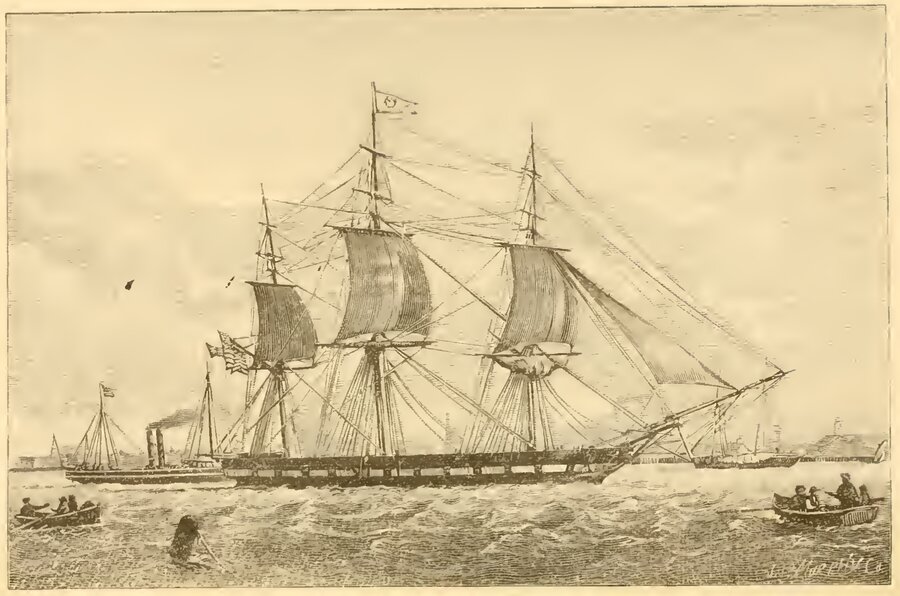
By the winter of 1847 the potato blight had brought famine to Ireland, and Americans were raising money and food for Irish relief. In February, Boston merchants petitioned Congress to lend them a warship to carry provisions. On March 3 Congress lent two, and since the navy was busy with the Mexican War, the Secretary of the Navy handed them over to private citizens to sail. The frigate Macedonian went to Captain George C. DeKay of New Jersey, and the sloop-of-war Jamestown to the Boston merchant and former sea captain Robert Bennet Forbes. The navy took out her guns, and on St. Patrick’s Day the Laborers’ Aid Society of Boston, “composed principally, if not entirely, of poor Irishmen,” came to the Charlestown Navy Yard and stowed a seventh of her cargo in a single day.
She sailed on March 28 with about 8,000 barrels of grain, meal and other provisions, and Forbes drove her across through snow, sleet and fog. On April 12, 1847, she anchored in Cork’s outer harbor “exactly 15 days and 3 hours from the Navy Yard, Charlestown, without having lost a rope yarn.” The town of Cove (now Cobh) was illuminated for her, and the temperance band played Yankee Doodle so often that Forbes concluded “the Irish consider it our only national anthem.” Then Father Theobald Mathew, the temperance priest, took him a few steps off one of Cork’s main streets into a lane of “hovels crowded with the sick and dying, without floors, without furniture,” and on to a soup kitchen “guarded by police officers,” where “hundreds of spectres stood without begging for some of this soup.”
That summer the Jamestown went back into naval service and sailed for the Mediterranean, where she stayed until 1850. The forebitter The Jamestown Homeward Bound probably comes from that cruise. After “three long years” of Sicily’s hills, Mount Vesuvius and the ruined walls of Pompeii, “and on them carved our names,” her crew are bound home at last for “freedom’s shore.”