Mutiny on the Bounty
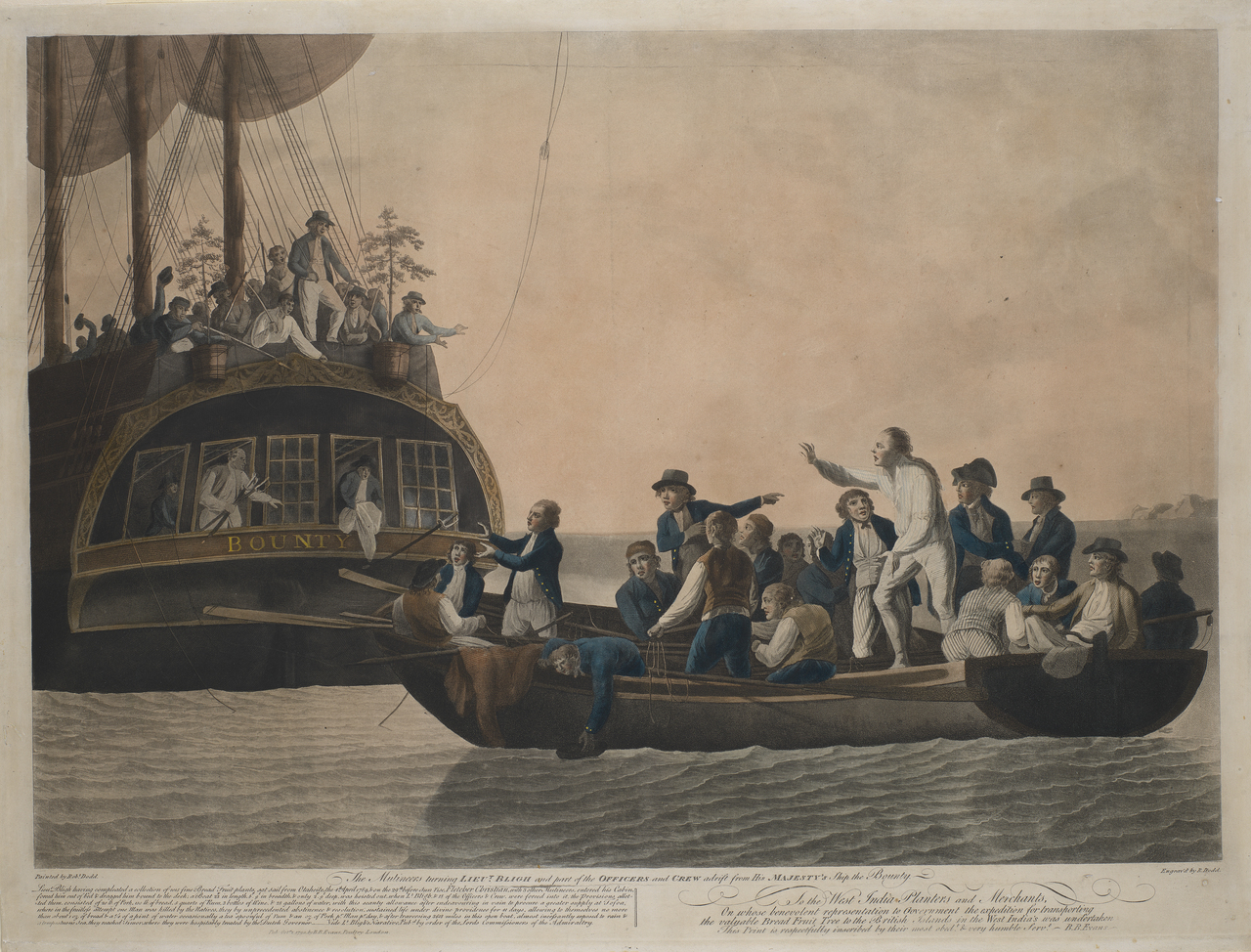
HMS Bounty was a small merchant ship bought by the Royal Navy for a single job: to carry breadfruit plants from Tahiti to the British West Indies, where they would be grown as cheap food for enslaved workers. Under Lieutenant William Bligh she sailed from England in December 1787 and reached Tahiti in October 1788. The crew spent five months ashore there while the plants were gathered. Bligh’s harsh tongue and the pull of Tahiti, where many had found partners, turned much of the crew against him. She sailed for home in April 1789, loaded with breadfruit.
On the morning of April 28, 1789, near the island of Tofua, the master’s mate Fletcher Christian led a mutiny. It was not long planned: the night before, after a row with Bligh, Christian had thought of deserting alone on a raft. Bligh wrote that “just before sun-rising, while I was yet asleep, Mr. Christian, with the master at arms, gunner’s mate, and Thomas Burkitt, seaman, came into my cabin, and seizing me tied my hands with a cord behind my back.” Bligh and eighteen loyal men were forced into the ship’s 23-foot launch and set adrift, while the mutineers cheered “Huzza for Otaheite!” Otaheite was the old English name for Tahiti. One of Bligh’s men was killed by islanders on Tofua. The rest sailed 3,618 miles in 41 days and reached the Dutch settlement at Coupang, on Timor, on June 14.
The Bounty went back to Tahiti. Some of the mutineers stayed there, and in 1791 HMS Pandora captured fourteen of them; three were later hanged. Christian took eight others, with a group of Tahitian men and women, to remote Pitcairn Island, where they burned the ship. Nothing was heard of them until 1808, when an American sealer called at Pitcairn and found one mutineer still alive. The pump shanty Bounty Was a Packet Ship tells the story from the forecastle, with Bligh as “Billy Blight, that silly man,” and it ends before anyone knew where the ship had gone: “Never was there heard a word, / From the crew that stayed on board.”