Death of Charles Dibdin
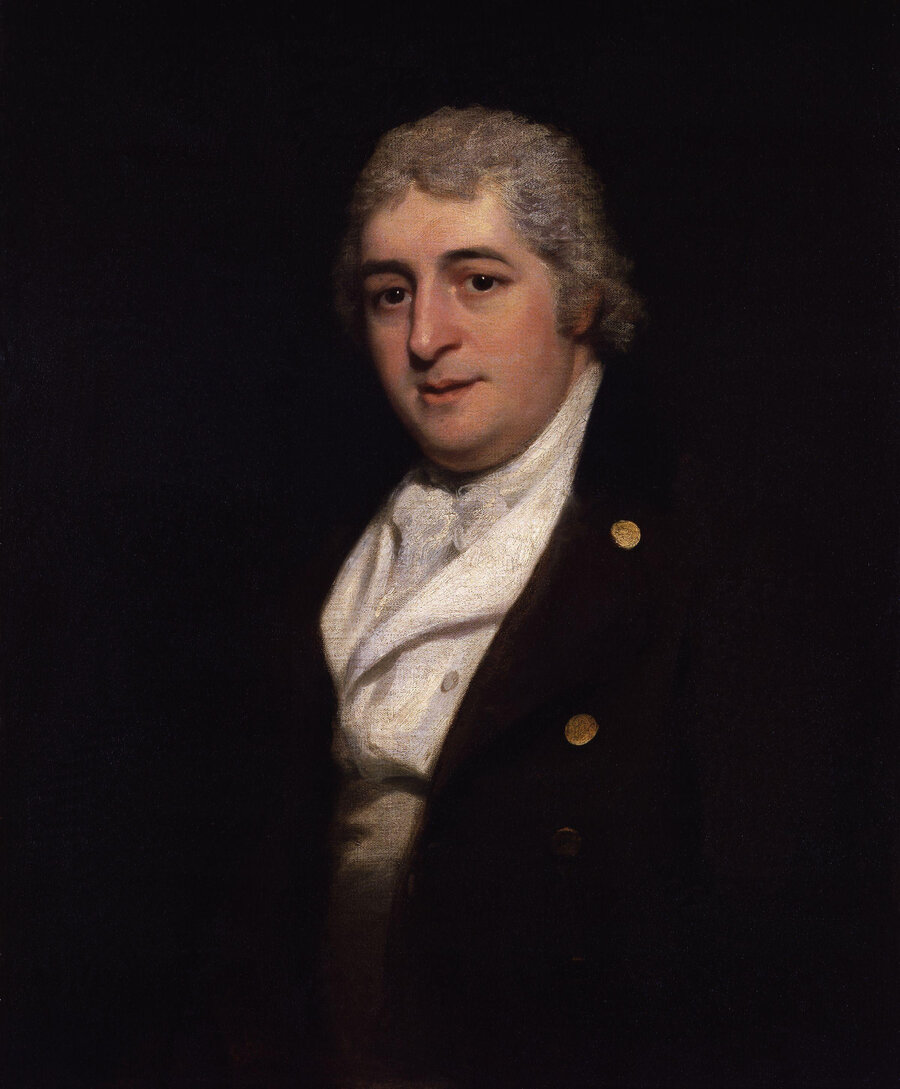
Charles Dibdin was born in Southampton in 1745 and sang as a boy in the choir of Winchester Cathedral. He never went to sea, but his elder brother Thomas did. Tom was captured by a 74-gun French warship while serving in the West Indiaman Hope, later commanded merchant ships, and died at the Cape of Good Hope on a voyage home from India after being struck by lightning. But Charles made his name in the London theaters as a composer and comic singer, and he wrote his first sea song, Blow High, Blow Low, in a gale during a thirteen-hour crossing from Calais. From 1789 he put on one-man “entertainments,” telling stories and singing his own songs while he accompanied himself on an instrument that, as the playwright John O’Keeffe put it, “was a concert in itself; he was, in fact, his own band.”
The wars with France made Charles useful to the government. He was paid to write, sing and give away “War Songs,” and in June 1803, with Britain expecting a French invasion, he was granted a pension of £200 a year. In 1805 he retired and sold the copyrights of three hundred songs, but when a new government took away his pension, he had to go back on the stage. He opened a music shop that failed and went bankrupt, and in 1810 his fellow musicians raised £640 for him at a public dinner. Paralyzed by a stroke in 1813, he died at his home in Arlington Street, Camden Town, on July 25, 1814, at the age of 69. He had boasted that “my songs have been the solace of sailors in long voyages, in storms, in battle; and they have been quoted in mutinies to the restoration of order and discipline,” and the Dictionary of National Biography later judged that “he brought more men into the navy in war time than all the press-gangs could.”
His most lasting song is Tom Bowline, written for The Oddities (1789) and said to be about his brother. Two of its lines are on Dibdin’s gravestone: “Though his body’s under hatches, / His soul is gone aloft!” Sailors sang it for half a century. In Herman Melville’s navy novel White-Jacket (1850), the old hands of the frigate’s crew are “the fellows that sing you” Tom Bowling. Half a century after his death, publishers still led with his name: Sea Songs and Ballads, a pocket songbook “by Dibdin and others,” opens with his Poor Jack and includes Ben Backstay. But by 1876 the Canadian captain Robert C. Adam could write that “Dibdin’s songs, which the orthodox sailor of the last half century was supposed to adhere to as closely as the Scotch Presbyterian to his Psalter, are falling into disuse.”