The Arethusa and the Belle Poule
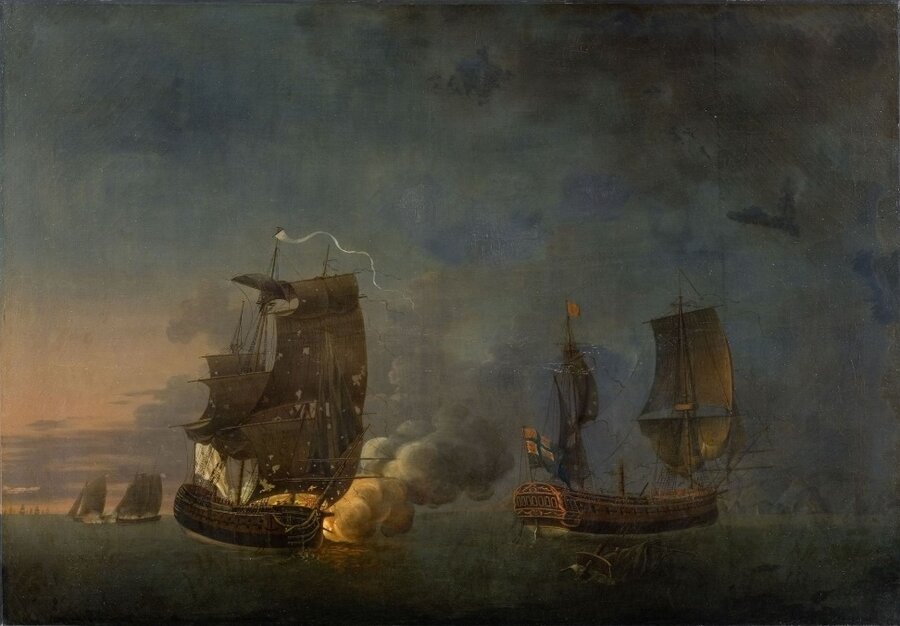
In the spring of 1778, France signed a treaty of alliance with the rebelling American colonies, and Britain and France drifted toward war without either one declaring it. Admiral Keppel took the Channel Fleet to sea to watch the French fleet at Brest. When his lookouts sighted a pair of French frigates on June 17, he sent ships to bring them in, so they could not carry home a report of his strength.
The British frigate HMS Arethusa, under Captain Samuel Marshall, overhauled the French frigate Belle Poule that evening. By the French account, Marshall hailed and “said he must come to her Admiral,” and the French commander, Lieutenant de la Clocheterie, answered that he would do no such thing. Each side later said the other fired first. The two frigates fought at pistol shot in a near calm from half past six until nearly midnight. The Arethusa lost her mainmast and had to be towed back to the fleet. The Belle Poule, with 40 dead and 57 wounded, anchored among the rocks near Plouescat on the Breton coast. Both countries claimed a victory. Louis XVI promoted Clocheterie and pensioned the families of the dead, and fashionable Parisian women wore their hair à la Belle Poule, piled high with a model frigate on top. A London paper grumbled that Marshall and his crew got nothing. Within a few weeks the two nations were formally at war, and they would be fighting on and off until 1815.
The British claim became The Saucy Arethusa, sung in Prince Hoare’s comic opera Lock and Key (1796) to William Shield’s setting of the old tune The Princess Royal. The words are usually credited to Hoare. Its third verse follows the French report almost line for line: “Bear down, d’ye see, to our Admiral’s lee.” “No, no,” says the Frenchman, “that can’t be.”