John Cabot Reaches North America
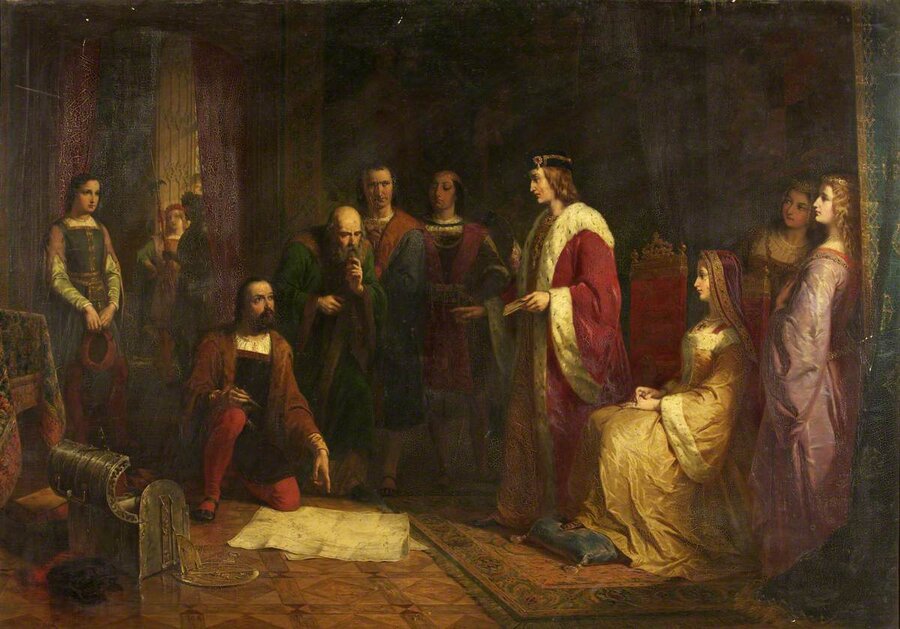
In 1496 King Henry VII gave a Venetian navigator, Zuan Caboto, known in England as John Cabot, a patent to sail west and claim new lands for England. Cabot believed he could reach Asia and its spices that way. His backers were merchants of Bristol, whose ships had been searching the Atlantic for a legendary island since 1480. In May 1497 he left Bristol in the Matthew, a small ship with a crew of about twenty.
After some 35 days at sea they sighted land. A Bristol chronicle gives the date as St. John the Baptist’s Day, June 24, 1497. Where they landed is still argued over, but it was probably Newfoundland or Cape Breton Island. Cabot went ashore at only one spot, raised the banners of the Pope and the King of England, found a trail and the remains of a fire, and went no farther inland than a crossbow shot. Then the Matthew spent about a month sailing along the coast. What the crew noticed most was the fish. “All along the coast they found many fish like those which in Iceland are dried in the open and sold in England,” wrote the Bristol merchant John Day, “and these fish are called in English ‘stockfish.’” Back in London, the crew told the Milanese ambassador that they could bring home so many fish “that this kingdom would have no further need of Iceland.” Cabot sailed again in 1498 with five ships, but what became of him is unknown.
For the next five hundred years, fishermen from Europe, and later from New England, sailed to the Grand Banks for cod. In A Trip to the Grand Banks, by Amos Hanson of Orland, Maine, the “Penobscot boys” fit out a schooner every spring “for the Grand Banks of Newfoundland their luck for to try.” They fish from dories through fog and gales, while big ships passing in the fog “sometimes run the schooners down.” The fishery lasted until the northern cod moratorium of 1992.