The Battle of Lake Erie
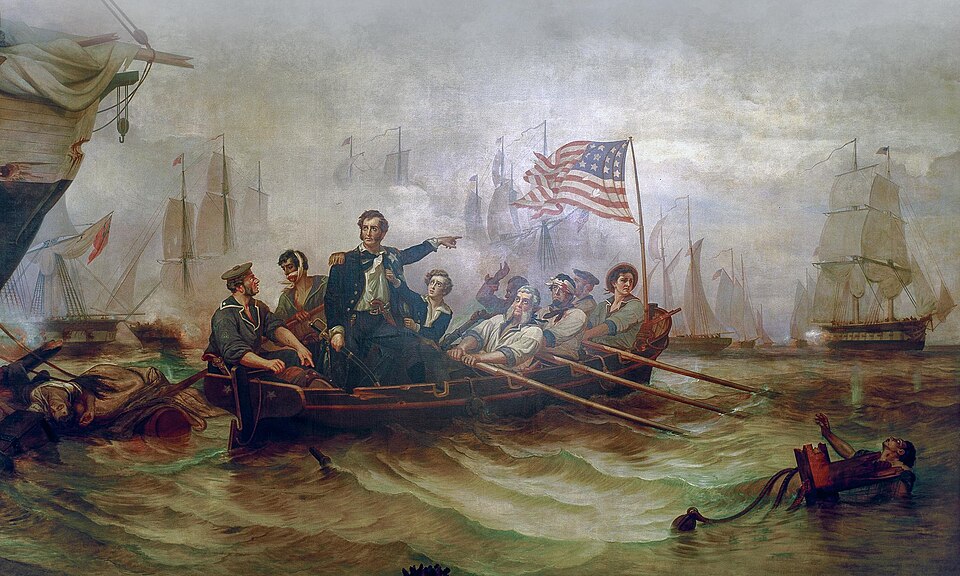
In August 1812 an American army surrendered Detroit, and the British took command of the upper Great Lakes. To win the Northwest back, the United States needed Lake Erie, and that meant building a navy on it. The job went to Oliver Hazard Perry, a 27-year-old officer from Rhode Island. Through the spring and summer of 1813 his shipwrights at Presque Isle, now Erie, Pennsylvania, built two brigs and a handful of schooners, and his men floated the brigs over the sandbar at the harbor mouth on scows. Perry named his flagship Lawrence, for Captain James Lawrence, killed aboard the Chesapeake in June, and had a blue battle flag made with Lawrence’s dying words: “Don’t give up the ship.” Across the lake, the British commander, Robert Barclay, a one-armed veteran of Trafalgar, had a new ship of his own, the Detroit.
On the morning of September 10, 1813, Perry’s lookouts sighted Barclay’s squadron from Put-in-Bay, in the Bass Islands. The wind was light, and it was nearly noon before the Detroit fired the first shot. Perry’s brigs carried carronades, heavy guns that hit hard but only at short range, so he took the Lawrence in close. The Niagara, under Jesse Elliott, hung back, for reasons argued over for decades, and for two hours the Lawrence took the fire of the British squadron nearly alone. By half past two every gun on her deck was knocked out. Of about a hundred fit men aboard, 22 were dead and 61 wounded. Perry got into a boat and was rowed half a mile through the shot to the Niagara, standing up until his oarsmen refused to pull unless he sat down. Behind him the Lawrence struck her colors, and the British cheered. Perry took the Niagara straight through Barclay’s line. The Detroit and the Queen Charlotte had fouled each other trying to turn, and the Niagara raked them both at close range. By three o’clock the British flags were down, and two small vessels that tried to run were chased down. Barclay lay below with grapeshot through his good shoulder. Perry wrote to General William Henry Harrison: “We have met the enemy, and they are ours. Two ships, two brigs, one schooner, and one sloop.” Within three weeks Harrison’s army was back in Detroit.
Ye Parliament of England is an American broadside that runs through the war at sea one verse at a time, from Isaac Hull’s capture of the Guerriere to the Enterprise and the Boxer, five days before Lake Erie. Then comes Lake Erie, “Where Perry had some fun,” and the British squadron “beat complete, / Some took, some run ashore.” The last verse still has the Essex raiding in the South Seas, so the song was probably written before she was captured in March 1814. When Joanna Carver Colcord printed it in Roll and Go in 1924, she wrote that it “was good for a fight any time there happened to be a Britisher in the forecastle!”