The Fall of Sevastopol
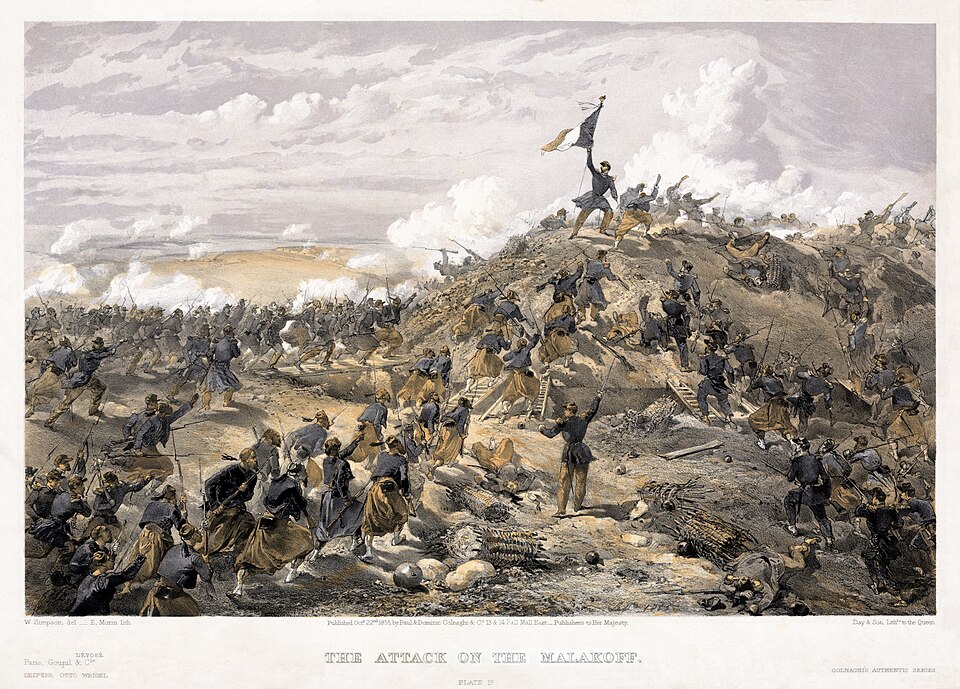
The Crimean War began in 1853 as a Russian push against the Ottoman Empire. Britain and France had spent centuries fighting each other, most recently at Waterloo, but neither would stand by while Russia grew stronger at the Ottomans’ expense, and in 1854 they joined the war on the Ottoman side. They struck at Sevastopol, home of Russia’s Black Sea Fleet, landing armies on the Crimean peninsula in September 1854. The Russians scuttled part of their own fleet across the harbor mouth to keep the allied warships out, and the allies settled in for a siege that lasted almost a year, through a winter of frostbite and disease. Sailors of the Naval Brigade hauled their ships’ guns ashore and manned them in the siege batteries.
The key to Sevastopol’s defenses was the Malakoff, a hill fort crowned by a stone tower. Its guns also covered the Great Redan, the British objective just to the west, so the British could not move until the Malakoff had fallen. By late summer the French trenches had reached within a few yards of the Malakoff, and at noon on Saturday, September 8, 1855, when the Russians were thought to be at dinner, the French charged. The fighting inside was carried on, wrote the French engineer General Niel, “with the bayonet, with the butt-ends, and stones,” and within fifteen minutes the tricolor was flying over the fort. Then the British went for the Redan across 200 yards of open ground, under fire the whole way. Some got inside, but after nearly two hours they were driven out. The allied fleets, meant to bombard the harbor forts, were pinned at anchor by a gale. That night the British commander, General James Simpson, wired London: “The assault on the Malakhoff has been successful… The attack of the English against the Redan did not succeed.” Without the Malakoff the town could not be held, and the Russians would leave nothing behind for the allies. Through the night they blew up their powder magazines, set Sevastopol ablaze, filed across a floating bridge to the north side of the harbor, and sank or burned what was left of their fleet. Next day Simpson wired again: “Sebastopol is in the possession of the allies.”
Guns fired a victory salute at the Tower of London and church bells rang across the city, but the celebration was halfhearted. The siege had been won by the French at the Malakoff, while the British had failed at the Redan. The war dragged on until the Treaty of Paris in March 1856. Street-ballad printers soon had Capture & Destruction of Sebastopol on sale, to the tune of Cheer, Boys, Cheer!, with the chorus “Cheer lads, cheer, Sebastopol is taken.” Sailors at the capstan had their own version, Sebastopol. “The Crimean war is over now,” it opens, months too early, and its chorus insists that “Old England gained the day,” a claim the men who stormed the Redan might have disputed. The shanty doesn’t seem to have been written down until John Masefield printed it in 1906 in his article Sea-Songs, calling it one of “the best, and most popular, capstan chanties,” with a tune that “moves to quicker time than most.”