Some men have crossed the briny deep
In dories, in the past;
And Captain Shackford, Portsmouth man,
Was first instead of last.
Then came the boat Red, White and Blue,
Which made the shortest trip,
And whose undeviating course
Gave voyagers a tip.
Then others ventured, one by one,
In crafts of strange appearance:
The John T. Ford, and Nonpareil,
Of sundry incoherence.
Now Alfred Johnsen, fisherman,
Had heard of these excursions,
Considered them indifferently
And stuck to his exertions
A-catching lusty halibut
On Newfoundland's famed banks,
And worthy citizen he was,
He rendered heartfelt thanks
Each time he sighted Gloucester lights,
When coming home from sea,
That he'd not gone to Davy Jones,
And was alive and free.
Young Alfred was a Danishman,
And loved his native land,
But when he reached the U.S.A.,
He felt his heart expand
To publicly proclaim
To manifold inhabitants
Of Gloucester-by-the-Sea,
His patriotic tendencies
And intrepidity.
So when his schooner set to sca,
Alf Johnsen stayed ashore,
Preparing for a bigger trip
Than all he'd made before.
Across the ocean he would sail
With neither dog nor cat,
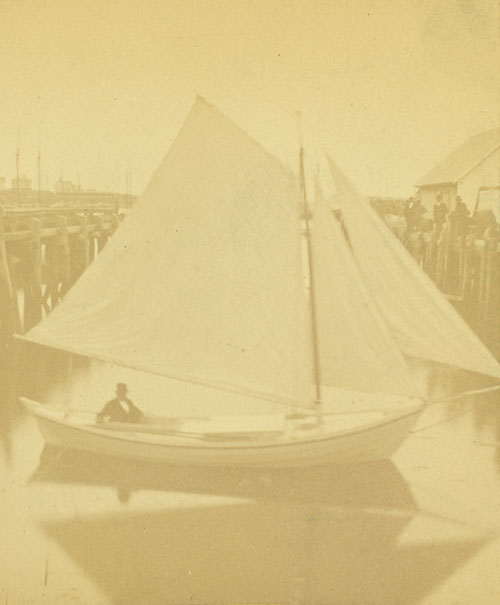
In sloop-rigged dory, overall,
Just twenty feet at that.
And so one day, a goodly crowd
Assembled on the shore,
To say farewell, for many feared
They'd see him nevermore.
'Twas fair and warm, in middle June,
When Johnsen waved goodbye,
But what his destiny would be
None dared to specify.
His dory named Centennial,
And Johnsen sailed along,
Unmindful of catastrophe
And pessimistic throng.
They sailed and sailed and sailed, for days,
Upon the deep blue sea,
And touched at Barrington, N.S.,
Around June twenty-three.
His compass points had been disturbed
By iron placed on board,
And when adjusted properly,
And matters in accord,
He headed east and instantly,
The waves rose high and wide,
And tossed and turned Centennial
Around, from side to side.
Alf followed in the steamship lane
And while he tossed about,
A liner sighted him afar
And gave a friendly shout:
"Ahoy! We'll rescue you," they cried,
When they were near at hand.
"How come your little dory strayed
So very far from land?"
"You cannot rescue me," said Alf.
"My port is Liverpool."
"It's hard to tell," the captain yelled,
"A wise man from a fool!"
"There's just one favor I would ask,"
Called Johnsen, ere they went.
"A tablespoon of Yankee rum
Would render me content."
"Sure thing!" they cried and tied a rope
Around a bottle neck,
And Johnsen leaped expectantly,
And nearly caused a wreck.
"Goodbye! good luck!" they called astern,
And disappeared from sight,
While Skipper Johnsen journeyed on
Into the lonely night.
He sailed and sailed and sailed some more,
And competently steered
His little craft successfully,
Till suddenly appeared,
To starboard, a gigantic fish—
A creature long and dark.
"All hands on deck!" the captain snapped.
"The bloody thing's a shark!"
Alas! alack! Centennial
Had only one for crew;
And to himself poor Johnsen said:
"Well, Alf, it's up to you.
"You cannot let the smallest craft
That ever crossed the sea
From Gloucester port to Liverpool
Go to eternity."
And so he grasped a sturdy oar,
And with a stalwart knife
Tied to its neck, he gave that shark
A battle for its life.
Till finally our fisherman
Attained the upper hand,
And wrathfully the shark swam off
For plunder nearer land.
"A lucky day for me," sighed Alf;
"Centennial and I
Have come too far to founder here,
And feed a fish and die."
And so they sailed and sailed some more,
And constantly he eyed
His mainsail, square-sail, tidy jibs,
With pardonable pride.
For days the angry sea was calm,
And Alf had time galore,
To think and think and think and think,
And then to think some more.
But mariners spend many hours
Alone upon the sea,
And do not find this solitude
A harsh calamity.
And so the days passed peacefully,
Until a storm rolled by,
And beat the water to a froth
And piled the waves sky-high.
And tossed and turned Centennial
And made her heel so far,
Her skipper thought his time had come
To cross the famous bar.
He saw the Maggie Gander pass,
Three hundred from Cape Clear,
And pitched and rolled so furiously,
'Twas difficult to steer.
He hove to, hoping Providence
Would moderate the gale;
But sad to say, calamity
Was close on Alfred's trail.
Abruptly, a colossal wave
Attacked him unaware,
And caught him broadside viciously,
And to his great despair,
Capsized Centennial and Alf,
Who ultimately found
The rude sea harshly battering
And beating them around.
In desperation, Johnsen clasped
The bottom of the boat,
And engineered with enterprise,
To keep them both afloat.
"The end has come too soon," he groaned,
When he could catch his breath.
"Unless I right her instantly,
I'll meet an early death."
So Alfred struggled violently,
With all his might and main,
But spite of youth and brawniness,
His efforts were in vain,
Till suddenly, a playful wave
Approached them both broadside,
And righted them and Alfred sat
Upon the deck astride.
"I'll rig a life-line from the mast,
And only sleep by day,
Or on some desert isle there'll be
Another castaway.
"I've been at sea without a wreck,
For forty-eight long days;
In twenty more I'll step ashore,
Without undue delays."
His food was moistened by the sea,
And some was gone for good,
But Alfred managed skillfully,
As any seaman would,
Until the brig Alfredon passed,
Bound south for Baltimore;
He spoke her and she gave him bread
To supplement his store.
On August ninth he hailed the ship
Lombardo, to petition
His bearings which he only knew
From general supposition.
And so he sailed and sailed again,
And stopped at Holyhead,
The eighteenth day at Liverpool,
And as the news had spread,
The shore was lined with Britishers,
Who sent a delegation
To bring the Yankee captain in
With fitting demonstration.
But Alfred was not overwhelmed:
"If I could cross the sea
Alone, then I can take her in
And land her safe," said he.
When queried if he'd sail again
Across the deep blue sea,
In sloop-rigged dory, Alfred said:
"Once was enough for me."
A master of a ship for years,
He settled down at last,
On solid earth to dream about
His years before the mast.
And daily played long rounds of bridge
With most astounding skill,
In rooms of Master Mariners,
And beat his friends until
They dared not trump his jack or ace
Or hesitate a trice;
He steered his cards a steady course
And offered good advice.
Since Johnsen's famous dory trip,
Throughout maturity,
He forfeited his Christian name,
And unofficially,
They christened him "Centennial,"
For in the hundredth year
Of independence, he set sail
Around the hemisphere.
Because as much as native sons,
He loved the U.S.A.,
And celebrated on the deep,
His Independence Day,
At eighty-odd he sailed away
Upon his final breaker,
Which piloted Centennial
To meet his mighty Maker.
Source: Gloucester Sea Ballads