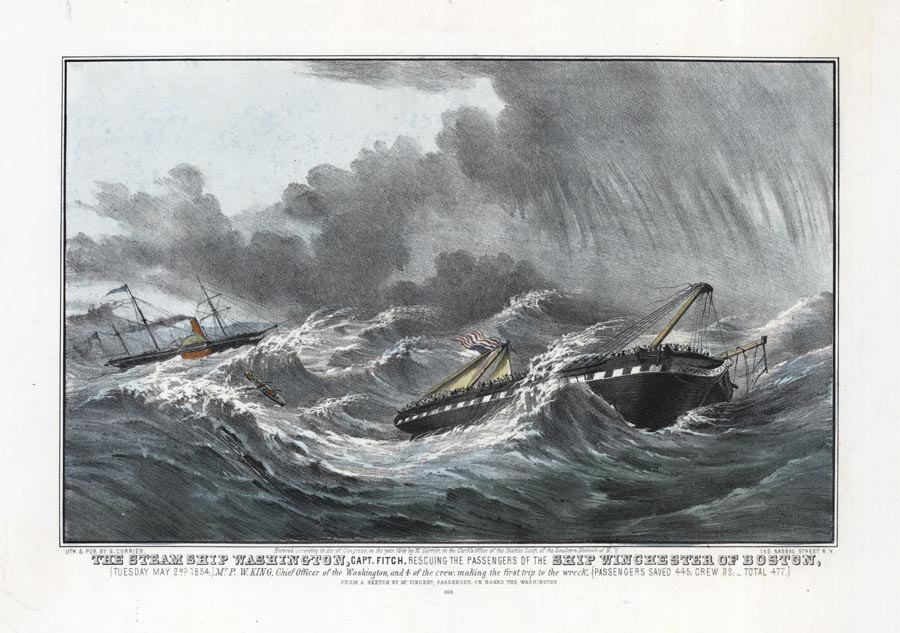
Song of the Steamship Washington
ChorusThree cheers for Fitch and King, Their names are given to fame, Three cheers for the gallant Washington, She's worthy of her name.The storm was howling o'er the sea; The elements warred fearfully. What cry breaks o'er our startled deck? It rings again— A wreck! a wreck! Far out upon the heaving sea, A foundering bark tossed helplessly. Her tall masts gone, her canvas riven, Show'd how vainly she had striven. Oh! who will board yon sinking bark? Cheer hearts where fears have gathered dark? Why leaps the heart, the tear-drops stir, When King cries out, "I'm ready, sir?" The boat is on the surging tide— God guard her to yon vessel's side; A cry of horror fills the air, She's gone— We gaze—no boat is there. But King is saved. Oh who can tell How glad the pledge he kept so well? "Keep up your hearts!" whate'er befal, "Our ship'll lie by— We'll save you all!" And ere the morrow's set of sun The pledge was kept, our task was done; The sun's last rays upon the wave Were gleaming o'er her ocean grave. Though storms may rage, we've naught to fear While Mathews is our engineer; If we can't use sails, we can use steam And our "iron horse" is a full team. Our Doctor Fullmer's prompt and quick, Worked hard on board to cure the sick; The poor emigrants will swell this strain, "They'll ne'er will see his like again." Here's to th' Washington, and those who made Her crew half horse, half alligator. We'll pass 'em round, or at least we oughter, For Fitch's a trump and King's a snorter.
Source: Christy and White's Ethiopian Melodies, 1854
Song of the Steamship Washington appears in Christy and White’s Ethiopian Melodies (1854), a minstrel songbook. According to the songbook, it was written on board the ship immediately after the rescue. The “Duda, duda” refrain suggests it may be derived from or related to Stephen Foster’s Camptown Races (1850), much like Banks of the Sacramento.
The song commemorates the rescue of passengers from the packet ship Winchester by the steamship Washington under Captain Fitch in spring 1854. The Winchester, under Captain Moore, had sailed from Liverpool bound for Boston. On April 17th, a gale sent Francis McGuire overboard while close-reefing the foretopsail; he drowned. Multiple sails and masts were lost, followed by three more men: William Young, Patrick Boyden, and Charles Wigging. By midday on the 18th, the ship was a complete wreck with all hands working the pumps. Philip Wilson suffered a broken leg when it was jammed between the spars.
Over the following days, the Winchester made contact with several ships and began offloading some 300 passengers. On May 2nd, the steamer Washington sent a boat to relieve the remaining passengers, along with about fifty barrels of provisions. In less than one hour, 446 souls were saved—including Captain Moore and his first officer, Mr. King—without a single reported accident or inconvenience.
(Source: New York Evening Post, May 15, 1854)
The final line uses 19th century slang: a “trump” (from the winning card in card games) meant a first-rate, reliable fellow, while a “snorter” meant someone remarkably spirited or exceptional.