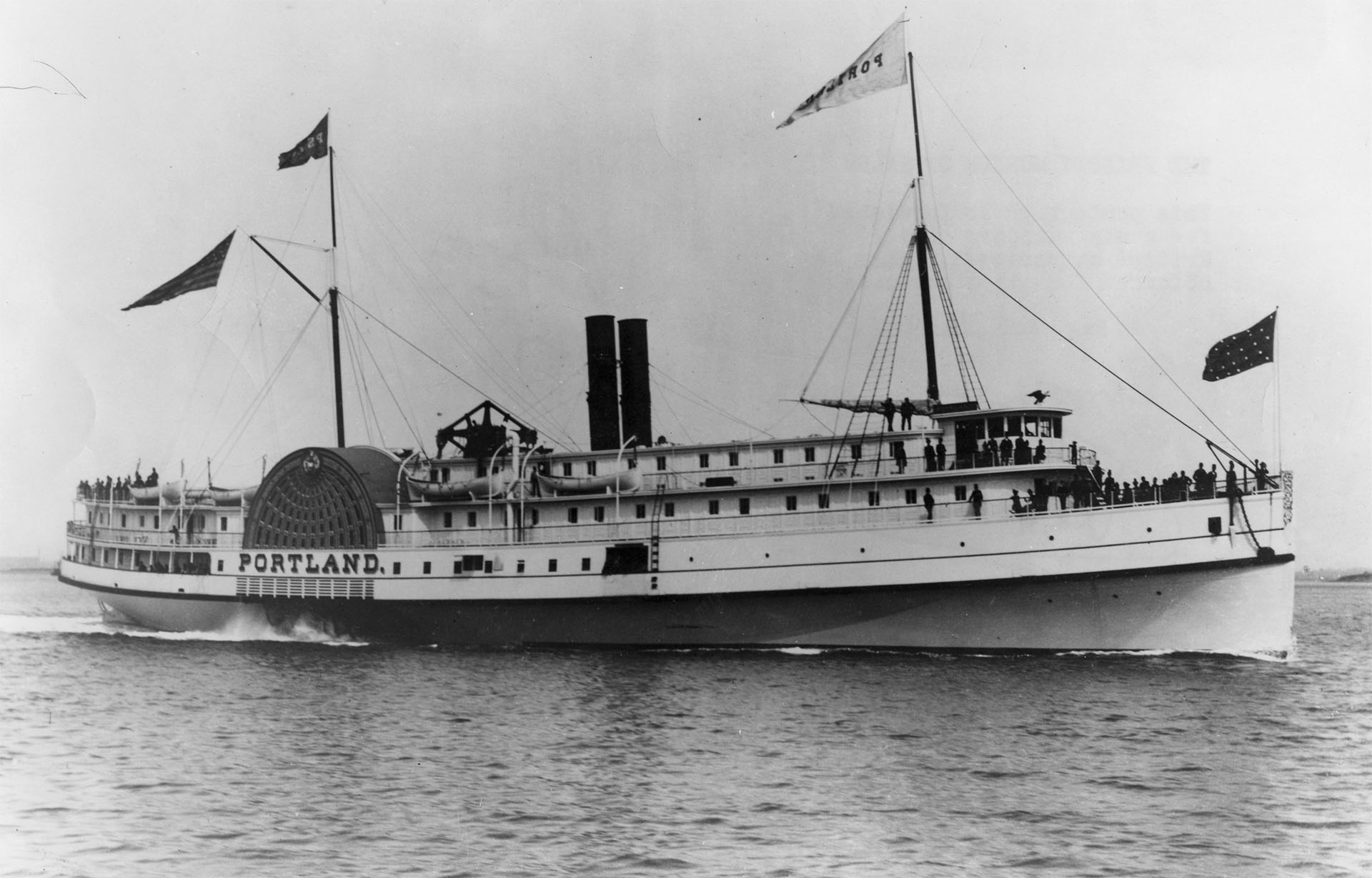
The Portland Gale
I'll tell you a tragic and sorrowful tale
Of shipwreck, that's known as the great "Portland Gale."
'Twas back in the nineties, the year that the Maine
Was sunk off Havana, in conflict with Spain;
The same year the Curies discovered in France
The metal which helped modern science advance.
The day of disaster, the paper said "fair,"
And none foreordained that black night of despair;
Word came from the south that a cyclone was due
From the Gulf any moment but only a few
Considered it grave and the rest went their way,
Disliking material plans to delay.
The Portland was sailing at seven p.m.,
A ship built in Bath and the positive gem
Of paddle-wheel steamers - not mere second rate-
The pride of her sister, the younger Bay State.
Enjoying her girlhood - a bare eight years old,
Acknowledged by many, a joy to behold,
She set forth as usual, despite good advice
To stick to her wharf and let caution suffice;
Her captain, H. Blanchard, though earnestly warned,
Believed it would pass and all arguments scorned.
"Twas after Thanksgiving, the holiday's end,
When folk were returning from family and friend.
On Saturday evening, the Portland set sail,
With under two hundred on board, strong and hale.
"The storm will escape us - it's headed nor'west,
Replied Captain Blanchard to someone's request.
And so they sailed forth, heading nor'east towards Maine,
Straight into the teeth of the fierce hurricane.
At seven-three-seven, it started to snow,
So gently and lightly that no one could know
The force of the tempest that lurked overhead,
Or how in the morning salt tears would be shed.
Unconscious of danger they glided awhile,
Along the New England coast, mile upon mile.
The Kennebec, heading for Bangor that night,
Was duly alarmed at the ominous sight
Of thick snowflakes whirling, as wilder it grew,
And straightway her captain exclaimed to the crew:
"We'll go back to Boston and tie up in port,
And thank the good Lord this excursion was short!"
The wind of a sudden turned into a gale,
The snowflakes fell faster and many a sail
Far out from the mainland went rushing to port,
Alert to discover a sheltered resort.
Each moment more savage the tumult became,
Till vigorous vessels grew crippled and lame.
"Oh please, Captain Blanchard, the night is so wild,
I long to return to my husband and child!"
We know some poor woman, half frantic with fear,
Implored the ship's captain, who scarcely could hear.
And others sobbed: "Spare us, dear Father, and guide
Our ship through this turbulent, furious tide!"
"Fear not, gentle lady," the calm captain said;
"We'll ride out the gale, there's nothing to dread.
"I've seen fiercer storms on a midsummer night,
And tossed on the sea till my teeth shook with fright."
And so, undisturbed in the imminent gale,
The Portland continued her perilous sail.
Quite close to nine-thirty, the good ship Maud S.
Was sou'west by four miles, or possibly less,
Of Thatcher's some five hundred feet from the shore.
"I never have seen her so near it before,"
Said Thomas, her skipper, half buried in foam,
As he skillfully piloted Maud closer home.
That evening again, Captains Godfrey and Streams,
Near Thatcher's espied her, so surely it seems,
She stayed in that neighborhood several hours,
While still in control of her seamanly powers.
Last seen bound nor'east by a Beverly schooner,
Some time before midnight - not very much sooner.
The Grayling, with Captain Rube Cameron, bound
for Gloucester, above the storm, heard not a sound
Till the Portland appeared across Cameron's bows,
East-nor'east of Thatcher's, that skipper allows;
So close was the steamer, he brandished a flare,
To caution them speedily, danger was there.
The hour was eleven, some miles from Cape Ann,
Soon after the ravaging whirlwind began;
The Portland displayed no marked signs of distress,
Though pitching and tossing about more or less.
She kept right on going nor'eastward, they said,
But made little progress in forging ahead.
They saw her no more, that infuriate night,
And no vessels lingered around Thatcher's Light;
All those who'd escaped were in shelter at last,
And others were drifting on bowsprit or mast;
Few ships could survive such a hurricane long,
No matter how seaworthy, able and strong.
And so, through the long night the Portland pitched on,
Believing the tumult would lessen anon;
Head into the gale she was fighting her way,
And constantly wandering farther astray.
The passengers hoped for a respite by morn,
As they waited uneasily, weary and worn.
Alas, when the dawn came, the wind howled and wailed,
And great apprehension and worry prevailed.
"We cannot survive in so angry a sea!"
The women lamented, in sharp agony.
"God spare us, we pray, and with powerful hand,
Restore us again to the safety of land."
The mariners said if the steamer had tried
To reach Gloucester harbor despite wind and tide,
Before the storm heightened and ocean waves tossed
Strong ships on the rocks and too many were lost,
She might have prevented her terrible fate,
That night in November, in eighteen nine-eight.
'Twas thought by most fishermen, skilled in the sea,
The Portland effected her last casualty,
By drifting from Thatcher's across to Cape Cod,
Where innocent passengers journeyed to God.
The next Sunday morning, between eight and nine,
Ruth Martin saw clearly, in sharp-cut outline,
A paddle-wheel steamer emerge close at hand,
As Ruth struggled feebly through rough seas towards land.
Much battered and bruised, she solicited aid,
But before she could speak, on the soft sand was laid,
By rude waves which carried her paddle-wheel friend
To harshly encounter a watery end.
That same Sunday morning, another large ship,
From New York to Rockland, was making a trip
To take Christmas toys to the merchants in Maine;
There too, off Cape Cod, all accounts ascertain,
Not far from the Portland, the Pentagoet tossed,
And long before midnight both vessels were lost.
Some thought that the paddle-wheel steamers collided,
And others, their hulls had completely divided;
While some say the fishing boat, Addie E. Snow,
Crashed into the Portland, but no one can know
The accurate details - she possibly hit
On the dread Peaked Hill Bars and incurably split.
No log can inform us - no coveted chart
Unfurls the dark mystery, even in part.
The Provincetown light-keeper stated her horn
Pronounced four sharp blasts, that deplorable morn;
But most thought the whistle, the vehement wind,
Severely deranging the old lighthouse blind.
No help was forthcoming that blizzardy day,
For destitute steamers that wandered astray;
The Portland was foundering somewhere at sea,
In poignant distress in the land of the free;
The passengers cherished faint hope of salvation
And prayed to be spared from complete devastation.
But none could resist her- too many had died
That night in November, swept on by the tide.
The wreckage was widespread, the shipwrecks stretched far,
On beachhead and island and sebulous bar;
Some darkly remember that horrible day
Of wretched disaster, with utter dismay.
One forty-one vessels were wrecked off the coast;
Four fifty-six persons all gave up the ghost,
That memorable day they discovered too late,
The force of the tempest of eighteen nine-eight.
Too tardy came wisdom and everyone sighed
To think on the Portland so many men died.
Long after their spirits ascended to God,
Their bodies were swept on the shores of Cape Cod.
A Gloucester man, Dunbar, the records attest,
Was found nearby Chatham, destroyed with the rest;
Bound nor'east for Boothbay, to visit his wife,
Another unfortunate forfeited life.
Next morning, the snowdrifts all over Cape Ann
Piled up towards the house-tops, and every strong man
Endeavored to mend the effects of the gale
Which loudly proclaimed its calamitous tale.
More men were destroyed in that storm on the main,
Than fell on the battlefield, fighting with Spain,
They dove for the Portland and strove to obtain
Her ill-fated body, but always in vain.
Small parts of the vessel rolled in with the tides,
but under the waters the mystery hides;
They still hope to find her and happ'ly reveal
The truth that the depths of the ocean conceal.
Old seamen converse on that harrowing time,
So often depicted in vigorous rhyme;
And frequently now as we carefully scan
The iron-bound coast of immortal Cape Ann,
We pray such catastrophe never prevail,
As this grimly deplorable, hideous gale!
Source: Gloucester Sea Ballads
The short description from Gloucester Sea Ballads reads:
The notorious gale of 1898, in which 141 vessels were lost and 456 people died.
On the night of November 26, 1898, a catastrophic storm struck New England, sinking 141 vessels and killing 456 people. The storm takes its name from the steamship Portland, which departed Boston that evening despite weather warnings and was lost with all hands off the Gloucester coast. The wreck was not located until 2002, when it was found at the bottom of Stellwagen Bank.