The Gloucester Sea Serpent
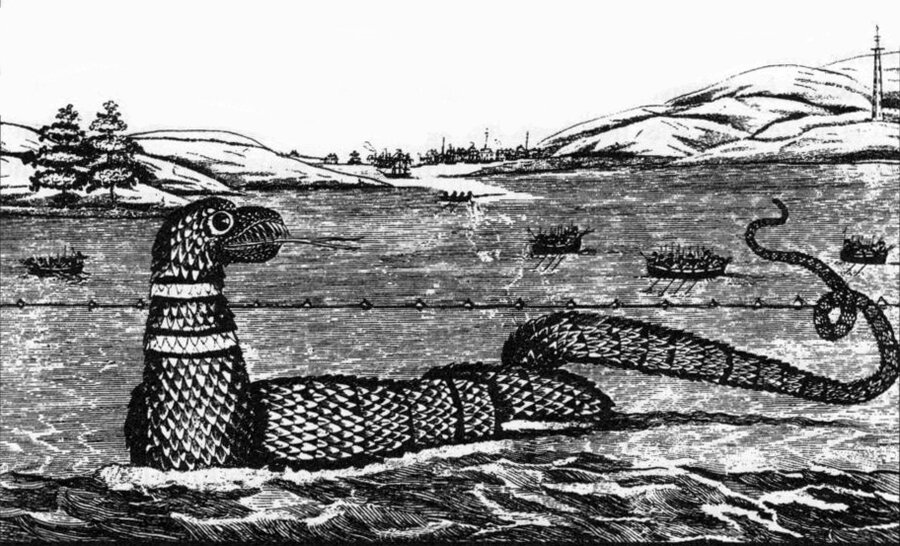
On August 10, 1817, a little after noon, a Gloucester mariner named Amos Story was sitting on the shore with a spyglass when he saw “a strange marine animal, that I believe to be a serpent” swimming near Ten Pound Island in the harbor. Its head was shaped like a sea turtle’s and held a foot above the water, and he watched it for an hour and a half. His is the earliest date in the sworn testimony that followed. The shipmaster Solomon Allen watched it on three days running and judged it eighty or ninety feet long, with a head like a rattlesnake’s but “nearly as large as the head of a horse.”
On August 14 the ship carpenter Matthew Gaffney was out in a boat with his brother and got within thirty feet of it. “I had a good gun, and took good aim,” he said. “I aimed at his head, and think I must have hit him.” The creature turned toward the boat, then sank “like a rock,” passed under them, and came up a hundred yards away, apparently unbothered. In Boston, the Linnaean Society of New England appointed a committee on August 18 to investigate. It asked a Gloucester justice of the peace, Lonson Nash, to take sworn statements, keeping the witnesses from comparing stories until all were written down. Nash, who had watched the animal himself on the 14th, sent back eight depositions on August 28, Story’s and Gaffney’s among them. Then, on September 27, men working in a field near Loblolly Cove killed a three-foot snake with a strangely humped back, using a pitchfork and a stone. Its owner exhibited it in Boston as the sea serpent’s young, and the committee, deciding the two were probably the same species, named a new genus for it, Scoliophis atlanticus. The naturalist Charles Lesueur soon showed it was a common black snake with a deformed spine.
The serpent was seen off Cape Ann for years afterward, and Gloucester never let go of it. In 1946 the local poet Kitty Parsons told the whole story again in comic verse as The Sea Serpent, in which Story, Allen and Gaffney each take a shot at it, until “most citizens of Gloucester thought they’d seen / The serpent or some specimen of animate marine.”