Smeaton's Eddystone Lighthouse Is Lit
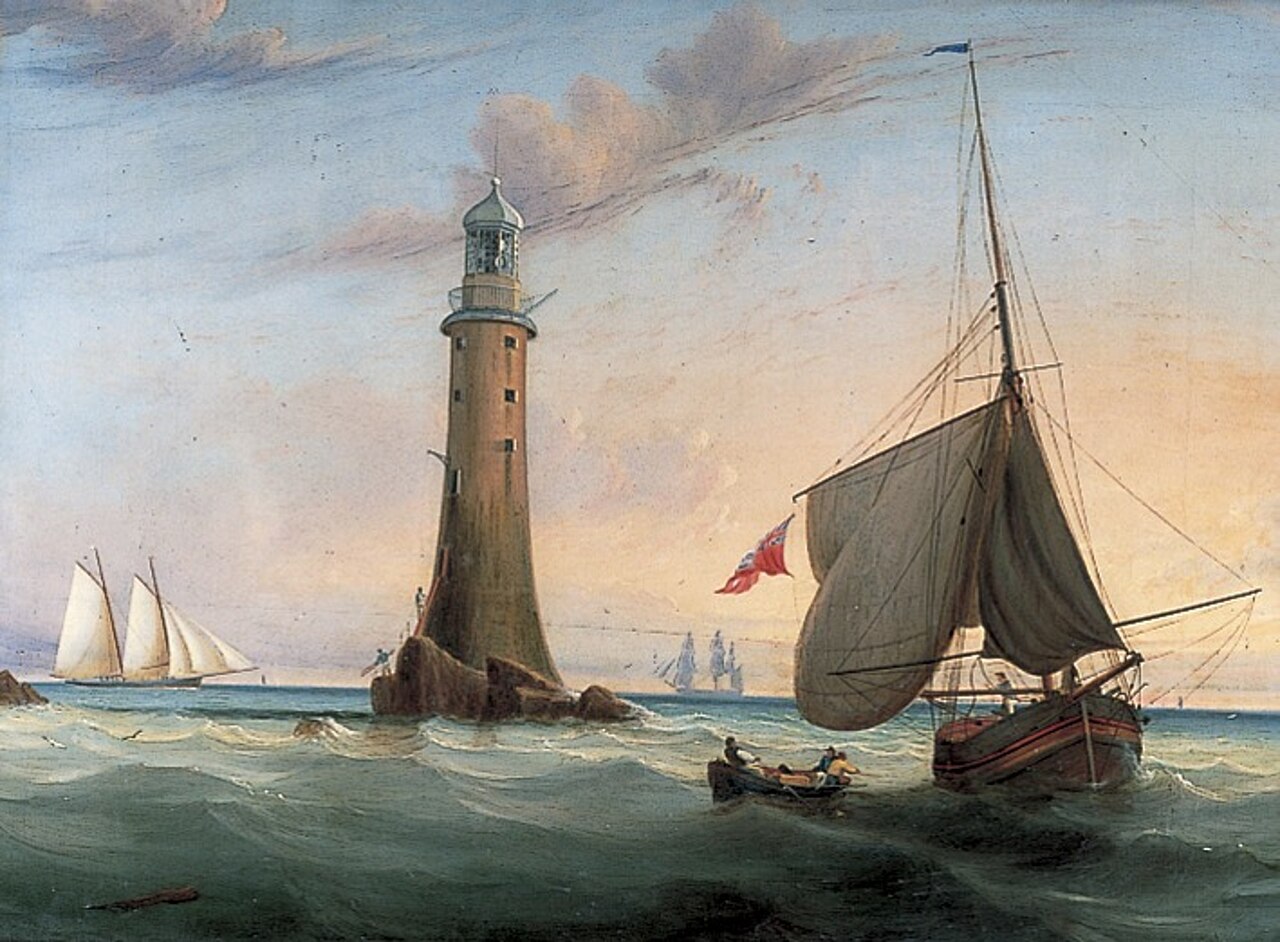
The Eddystone Rocks lie in the English Channel about nine miles south of Rame Head, off the approach to Plymouth, and for centuries they wrecked ships. The first lighthouse on them was Henry Winstanley’s wooden tower, lit in 1698. Winstanley was on the rock making repairs when the Great Storm of November 1703 struck, and the tower was swept away with everyone in it. John Rudyerd’s tower of timber and stone followed in 1708 and stood for almost fifty years, until the lantern caught fire on the night of December 2, 1755. Its keeper, Henry Hall, was 94. He said he had swallowed molten lead from the lantern roof while fighting the fire, and he died some days later.
The engineer John Smeaton built the next tower entirely of stone. He took its shape from “the natural figure of the waist or bole of a large spreading Oak,” and cut the granite blocks to dovetail into one another and into the rock itself, bound with a lime mortar that set under water. Work on the rock began in 1756. On October 16, 1759, the light was lit for the first time, with 24 tallow candles. When Smeaton got back out to the rock a few days later, Henry Edwards, one of the three workmen he had left to keep the light, told him “they lighted the house, as they were directed, early on Tuesday evening the 16th… and that they found the lights to burn very steadily, notwithstanding it blowed very hard.” The tower stood for more than a century, until the rock beneath it began to erode. Its upper part was taken down and rebuilt on Plymouth Hoe, where it still stands, and James Douglass’s new tower took over the light in 1882.
By then the Eddystone was the best-known lighthouse in Britain. The comic song The Eddystone Light began as The Man at the Nore, a music hall song of 1866 about the keeper of the Nore lightship in the Thames Estuary. Later versions moved him to the Eddystone, where he “slept with a mermaid one fine night,” and the Weavers and Burl Ives made it a folk revival standard in the 1950s.