Moby-Dick Is Published in London as The Whale
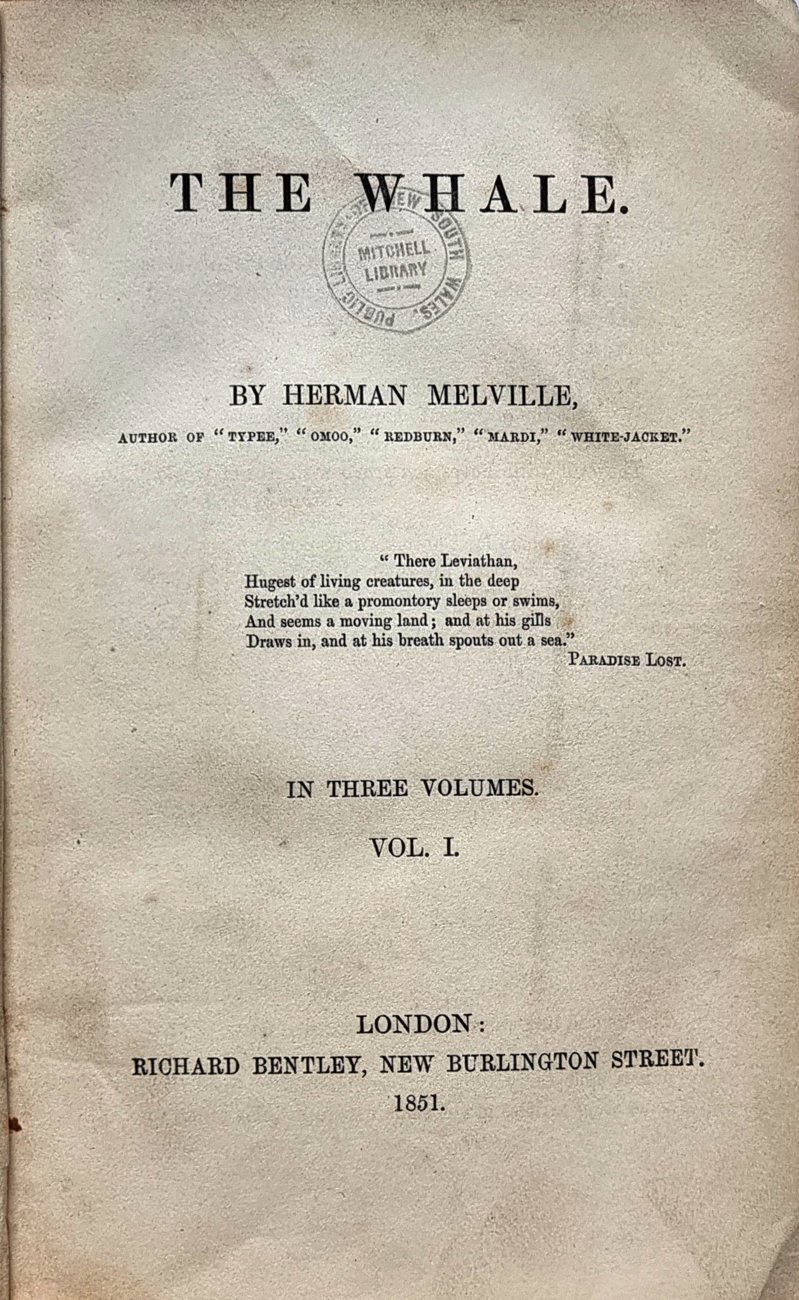
Herman Melville went to sea in the whaler Acushnet out of Fairhaven, Massachusetts, in January 1841, and deserted her in the Marquesas the next year. Over the following decade he turned his years at sea into a run of novels, from Typee (1846) to White-Jacket (1850). His sixth book took in everything he knew about whaling, along with the story of the Nantucket whaler Essex, rammed and sunk by a sperm whale in 1820.
On October 18, 1851, Richard Bentley published it in London, in three volumes, as The Whale. He printed 500 copies. Bentley’s editors cut passages they thought offensive, and the Epilogue, in which Ishmael survives the wreck of the Pequod, was left out, so some reviewers asked how the narrator had lived to tell the story. Harper & Brothers published the American edition in New York on November 14 under a new title, Moby-Dick; or, The Whale. The book sold poorly, and it was only in the 1920s, after Melville’s death, that it came to be seen as a great American novel.
The Pequod’s crew sing as they work. When the ship weighs anchor in chapter 22, the hands at the windlass roar “some sort of a chorus about the girls in Booble Alley,” though Captain Bildad had told them that no profane songs would be allowed on board. Chapter 40, “Midnight, Forecastle,” opens with the watch “all singing in chorus” the old song Spanish Ladies: “Farewell and adieu to you, Spanish ladies! Farewell and adieu to you, ladies of Spain!” Melville came back to the song near the end of his life in Tom Deadlight (1888), the dying words of a petty officer, which borrow its lines. When John Huston filmed the novel in 1956, A.L. Lloyd led the shanties, among them Blood Red Roses.