Admiral Nelson and the Battle of Trafalgar
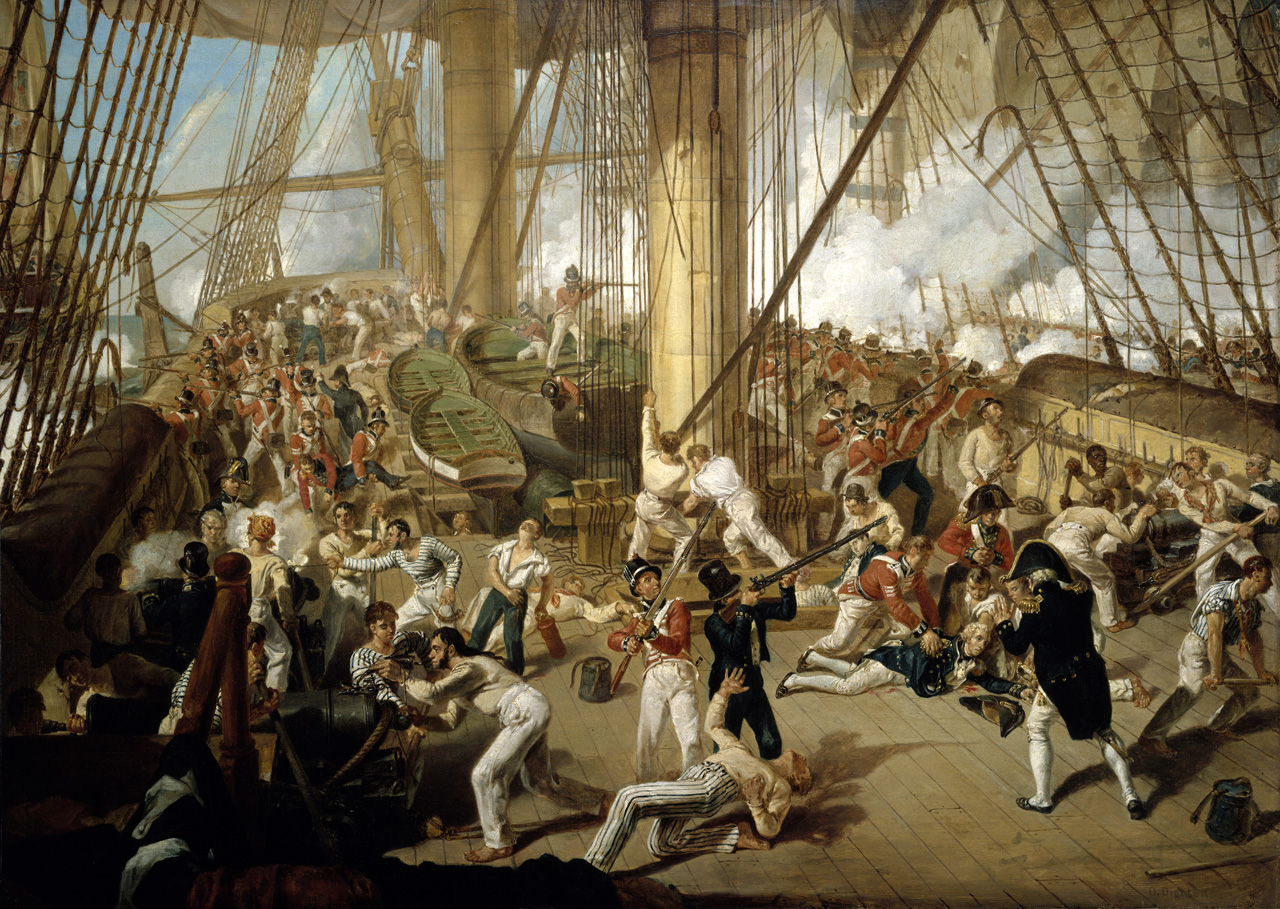
By the autumn of 1805, Napoleon had assembled a vast army at Boulogne for the invasion of England, but he needed control of the English Channel to get it across. That depended on the combined fleets of France and Spain, which had taken shelter in the port of Cadiz under the command of Vice Admiral Pierre-Charles Villeneuve. When Villeneuve put to sea on October 19, Vice Admiral Horatio Nelson was waiting for him with 27 ships of the line. The combined fleet had 33, with a corresponding advantage in guns, but Nelson had a plan and better crews.
On the morning of October 21, the allied fleet was sailing north in a loose crescent. Nelson divided his force into two columns and drove them directly at the enemy line, perpendicular to it, a maneuver that risked terrible punishment on the approach but would cut the allied formation into pieces and prevent the van from doubling back in time to help. It worked. The fighting was brutal and close, ship against ship at point-blank range, but by late afternoon the combined fleet had lost some twenty vessels captured or destroyed, with roughly 4,500 killed and 14,000 taken prisoner. The British lost no ships, though 449 men were killed and over a thousand wounded. Among the dead was Nelson himself, struck by a musket ball fired from the rigging of the Redoutable at the height of the action.
Trafalgar ended any serious threat of a French invasion and secured British naval supremacy for a century. Nelson became the supreme hero of the age, mourned by the whole nation. He appears in numerous songs of the tradition, including Nelson's Death, Nelson's Death and Victory, On Board a Ninety-Eight, and Carrying Nelson Home.
For the ballads, stage songs, and shanties that grew up around the battle, see Mourn, England, Mourn: The Songs of Nelson and Trafalgar.