Early on the morning of November 6, 1805, Lieutenant John Lapenotière of the British schooner Pickle arrived at the Admiralty in Whitehall, London, with Admiral Collingwood’s dispatches. He had landed at Falmouth two days before and covered the 271 miles to London in 37 hours by hired coach, changing horses all along the road. He was carrying two pieces of news: the combined fleets of France and Spain had been beaten off Cape Trafalgar, and Lord Nelson was dead.
An anonymous songwriter put it into four lines that country people were still singing more than a century later:
All Britons long expected good news from our fleet,Commanded by Lord Nelson, the French for to meet,Till at length the news come over through the country was spread,That the French were defeated but Nelson was dead.
Few events in naval history left as much music behind them. There were tunes played on the approach to the battle, a flood of broadsides after it, a stage aria that became one of the best-known songs of the nineteenth century, and laments that English singers carried into the age of the tape recorder. Decades later, merchant sailors were still singing about Nelson in their shanties, though by then his name had become slang for rum. Here is a guide to that music.
“All our ships that had bands were playing”
The battle itself began with music. The wind was light that morning and the British columns crept toward the enemy line at walking pace, taking fire for the better part of an hour before they could answer it. Frederick Hoffman, a lieutenant aboard the 80-gun Tonnant, remembered the sound of it: Frederick Hoffman, A Sailor of King George: The Journals of Captain Frederick Hoffman, R.N., 1793–1814 (London, 1901). Hoffman was senior lieutenant of the Tonnant’s lower deck at Trafalgar and was slightly wounded in the hand.
All our ships that had bands were playing “Rule Britannia,” “Downfall of Paris,” etc. Our own struck up “Britons, strike home.” We were so slow in moving through the water in consequence of the lightness of the wind that some of the enemy’s ships gave us a royal salute before we could break their line, and we lost two of the band and had nine wounded before we opened our fire.
The playlist is worth a moment. “Rule, Britannia!” was Thomas Arne’s anthem from 1740. “Britons, Strike Home!” was older still, a call to arms from Henry Purcell’s music for Bonduca (1695). “The Downfall of Paris” was a British quick march built partly on “Ça ira,” the marching song of the French Revolution.
Hoffman also recorded that when Nelson’s famous signal went up, “England expects that every man will do his duty,” it “was answered with three hearty cheers from each ship.”
“At least a dozen” ballads
Back home, the broadside printers went to work. Broadsides were single sheets of song lyrics, sold for a penny or less by street singers who would perform the song to sell it. A great victory and a dead hero made ideal material. When the historian C.H. Firth surveyed the naval ballads of the period for his Naval Songs and Ballads (1908), he counted the results with some disdain: C.H. Firth, Naval Songs and Ballads (Navy Records Society, 1908), introduction, pp. c–ci. The ballads quoted here appear on pp. 301–305.
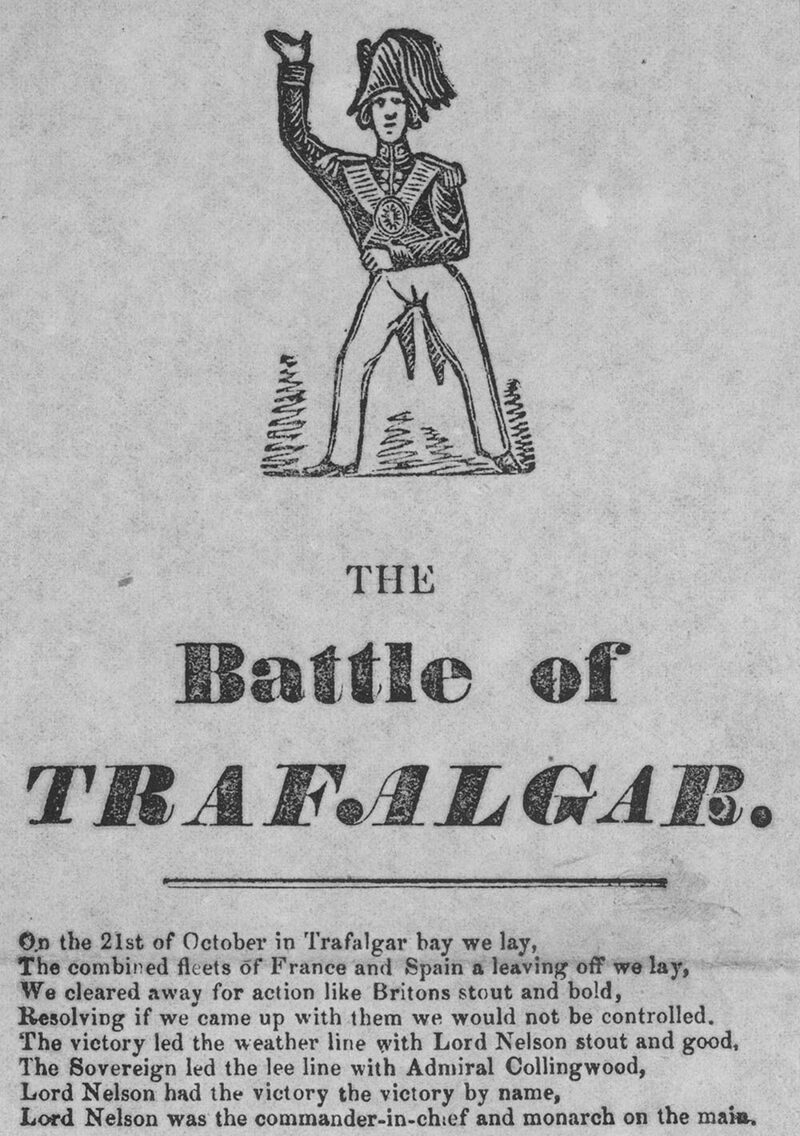
The period from the renewal of the war with France in May 1803 to the general peace in 1815 supplies few ballads of any merit, and the more important the event celebrated the worse, as a rule, is the ballad. Trafalgar produced at least a dozen.
The broadside Battle of Trafalgar starts with a fine, salty opening about the frigates repeating signals off Cádiz, then dissolves into what Firth called “a mere catalogue of the names of ships.” But the cheap ballads were often surprisingly close to the facts. Nelson’s Glorious Victory at Trafalgar has the admiral counting the enemy fleet:
Their ships in number thirty-three,And Nelson, when he did them see,Said, “Twenty then there is for me.”O brave Nelson!
That sounds like ballad bluster, but Nelson really did tell Captain Hardy that morning that “he would not be contented with capturing less than twenty sail of the line.” As he lay dying he was told that fourteen or fifteen had struck, and he answered, “That is well, but I bargained for twenty.” William Beatty, Authentic Narrative of the Death of Lord Nelson (London, 1807). Beatty was surgeon of the Victory and attended Nelson in the cockpit until he died.
Ballad makers usually set their words to tunes their audience already knew and loved. A familiar melody made a new song easy to pick up and easy to sell, and the most patriotic tune of all was Heart of Oak, David Garrick and William Boyce’s song from 1759, which later became the official march of the Royal Navy. Within two weeks of Trafalgar, Sir Richard Strachan captured four more French ships that had escaped the battle, and a ballad celebrating “Admiral Strachan’s Victory” was set to it: “Though with tears we lament our great Nelson’s demise, / Let the nation rejoice that more Nelsons arise.”
Nelson’s Death: the ballad that lasted
Of all those songs, the one that survived best is the one Firth thought least of. He reprinted it as A New Song Composed on the Death of Lord Nelson, calling it “a rough and ungrammatical popular ballad” that nonetheless deserved a place “as a testimony to popular feeling in England.” Today it’s usually called Nelson’s Death, and its refrain is as plain as grief gets:
Mourn, England, mourn, mourn and complain,For the loss of Lord Nelson who died on the main.
For a “rough” ballad, it stays remarkably close to what actually happened in the Victory’s cockpit. In the song, the doctor hurries to Nelson’s side, and Nelson waves him away:
“No matter, and no matter, whatever about me,It’s to my gallant seamen your first duty should be.”
The ship’s surgeon, William Beatty, published his account of Nelson’s death in 1807. He recorded that Nelson asked him “to return to the wounded, and give his assistance to such of them as he could be useful to; for, said he, ‘you can do nothing for me.’” The ballad has Nelson calling to his captain, “How does the battle go?” Beatty has him asking Hardy, “how goes the battle? How goes the day with us?” Whoever wrote the ballad had either read the published accounts or heard them retold.
The printed copies held in the Bodleian Libraries date from the decades after the battle, and the song kept moving long after the printers stopped. In 1847 a sailor named William Histed copied the opening verse into his journal aboard the New Bedford whaler Cortes. Trafalgar was more than forty years in the past, and the song had crossed the Atlantic to the crews of American whaleships. Histed’s version comes with a tune:
When folk song collectors went out into the English countryside at the start of the twentieth century, they found the song still being sung. Cecil Sharp took it down from Mrs. Lock of Muchelney Ham, Somerset, in 1904. Percy Grainger recorded it from George Wray in 1906, and Ralph Vaughan Williams found it in Hampshire. The great Norfolk singer Harry Cox was recorded singing it in 1953, and A.L. Lloyd said he sang it “with sorrowful dignity.” Lloyd later pieced together the version most people know today for The Valiant Sailor (1973), joining a Hampshire tune to verses from nineteenth-century broadsides.
‘Twas in Trafalgar’s Bay
There is a second, better-known Death of Nelson, and it came from the stage. On April 27, 1811, the tenor John Braham premiered a new opera called The Americans at the Lyceum Theatre in London. Its big number, with words by Samuel James Arnold and music by Braham himself, was The Death of Nelson:
‘Twas in Trafalgar’s bayWe saw the Frenchman lay,Each heart was bounding then.We scorned the foreign yoke,For our Ships were British Oak,And hearts of oak our men!Our Nelson mark’d them on the wave,Three cheers our gallant Seamen gave,Nor thought of home or beauty.Along the line this signal ran,England expects that ev’ry manThis day will do his duty!
The three cheers that Hoffman heard made it into the song, along with a nod to Heart of Oak. This was a theater song, built for a trained tenor and a full orchestra, and it became one of the most popular songs of the century. Lady Hamilton, Nelson’s mistress, was reported to have been so overcome at an early performance that she had to leave the theater.
Decades later the song was still so familiar that Charles Dickens could turn it into a joke. In David Copperfield (1850), a drunken old clothes dealer keeps young David waiting all day for his money while he lies inside his shop howling the “Death of Nelson,” “with an Oh! before every line, and innumerable Goroos interspersed.” Charles Dickens, David Copperfield, chapter 13.
On board the man-o’-war
A second broadside, usually titled Nelson’s Death and Victory, opens “Ye sons of Britain in chorus join and sing.” One printing gets the date wrong, placing the battle on August 21 instead of October 21. The song might have stayed in the archives if not for George Dunn, a chainmaker from Quarry Bank in the Black Country. In 1971 he sang a version to the collector Roy Palmer with the date put right and a new refrain:
‘Twas the twenty-first of October before the rising sunWe formed a line for action, my boys, at twelve o’clock begun…Were killed and wounded on that dayOn board a man-o’-war.
Peter Bellamy liked Dunn’s tune so much that he built a longer song around it for his Maritime England Suite (1982), borrowing extra verses from Harry Cox. “This is actually two songs,” Bellamy explained, “because the tune was too good to waste on just three verses.”
The view from the lower deck
Not every Trafalgar song is about Nelson. Some are about the men who were there because they had no choice. On Board a Ninety-Eight tells the story of a young man taken by the press gang, hardened by years at sea, wounded at Trafalgar, and retired at last to the naval hospital at Greenwich. “They’ve only knocked a wing off Jack,” he says. Its happy ending, as Roy Palmer noted, was “by no means always true to life.” On Board of the Victory is sung by a woman whose sweetheart has been pressed into Nelson’s flagship. It is really a song about separation, and the battle barely appears in it. It was still being sung in Canada when Helen Creighton collected it in the 1950s.
Both songs appear in Roy Palmer’s The Valiant Sailor (1973), a collection of “sea songs, ballads, and prose passages illustrating life on the lower deck in Nelson’s Navy,” and on its companion album. For Nelson’s earlier victories, see The Banks of the Nile, set during the 1798 campaign in Egypt, and Nelson’s Victory at Copenhagen, a broadside printed while Nelson was still alive.
A drop of Nelson’s Blood
By the time the merchant sailors of the 1800s were singing shanties at the capstan and halyards, Trafalgar was half a century behind them, but Nelson had not gone away. He had turned into rum. “A drop of Nelson’s blood wouldn’t do us any harm,” runs one verse of Roll the Old Chariot, and “a bottle of Nelson’s Blood” turns up in Flash Gals of the Town too. Stan Hugill gave the apocryphal explanation: Nelson’s body was brought home in a cask of rum, and the crew bored a hole in the cask and drank it dry on the way. From then on, broaching a cask on the sly was “bleedin’ the admiral,” and rum was Nelson’s Blood.
It’s a wonderful story, and Beatty’s account takes most of the fun out of it. The body was preserved in brandy, not rum, in a large cask called a leaguer, kept on the middle deck under a sentry. At Gibraltar the cask was topped up with spirit of wine, “shewing a deficit produced by the Body’s absorbing a considerable quantity of the brandy.” The surgeon even felt the need to add a footnote. When the Victory reached England, he wrote, he found “a very general but erroneous opinion” that rum would have been the better choice.
The shantymen kept the rest of the war in mind too. Boney Was a Warrior tells Napoleon’s whole career in a handful of lines, from “Boney went to Waterloo” to “Away in St. Helena,” and in some versions the ship that took him into exile, the Bellerophon, becomes the “Billy Ruffian.” William Alden heard it as a windlass song and printed it in his 1882 essay on sailor songs.
Carrying Nelson home
Nelson was buried at St. Paul’s Cathedral on January 9, 1806, after his coffin was rowed up the Thames from Greenwich the day before in one of the grandest processions the river had ever seen (see January 8). When the coffin was lowered into the grave, sailors from the Victory laid the ship’s furled flags in after it. But first, as the Naval Chronicle reported, they “had torn off a considerable part of the largest flag, of which most of them obtained a portion,” to keep as memorials of their commander. The Naval Chronicle, vol. 15 (January to June 1806), p. 233, in its account of the funeral at St. Paul’s on January 9, 1806.
The songs have not stopped. Mike O’Connor’s Carrying Nelson Home is a modern piece that follows the Victory on her slow voyage north from Cádiz with the admiral aboard. It’s written in the language of sail handling, easing the bow spring and shaking out the topsails, and it ends with the line, “lower me easy, I’m going ashore one last time.”
The anniversary of the battle, October 21, is still commemorated as Trafalgar Day. For the battle itself, see the October 21 entry on Nelson and the Battle of Trafalgar, and browse every song that mentions Lord Nelson.