Burning of the Royal Tar
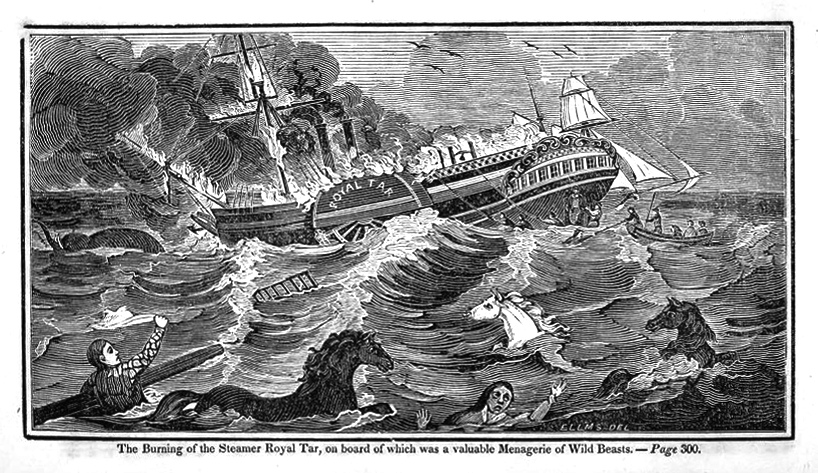
The Royal Tar was a 164-foot wooden side-wheel steamer built in Saint John, New Brunswick, in 1835. On October 21, 1836, she departed Eastport, Maine for Portland carrying 72 passengers, 21 crew, a brass band, and the entire Burgess and Dexter’s Zoological Institute, a traveling circus. The menagerie included an elephant named Mogul, a Bengal tiger, two lions, a zebra, a hyena, two camels, exotic snakes and birds, and horses with show wagons. To make room for the animal cages, two of the ship’s four lifeboats had been removed.
Heavy weather delayed the voyage for three days. On the afternoon of October 25, while sheltering in Penobscot Bay near the Fox Islands, the engineer discovered the boiler water had fallen dangerously low. Captain Thomas Reed ordered the engine stopped and the furnace fire extinguished, but flames were soon discovered under the middle deck near the animal cages. High winds fanned the blaze beyond control. Mogul the elephant, panicked by the fire, charged through the smoke and leaped overboard, capsizing a makeshift raft of planks and ladders on which several passengers clung for their lives. The U.S. Revenue Cutter Veto arrived within the half hour and rescued some sixty survivors. Fisherman William Barter of Isle au Haut pulled others from the water and fed them beans, bread, and lamb. In the end, 33 people perished, and all the circus animals save the two horses were lost. Also lost was the ship’s safe, which held the passengers’ valuables and money, estimated to be worth over $1 million today. Salvage crews tried to recover it in the 1850s and again in 1930, but found nothing of value. A 1953 expedition could not even locate the wreckage.
The disaster inspired Arthur Slader’s 1837 poem “The Burning Boat,” published as a pamphlet in Saint John. Over a century later, the Maine folk group Schooner Fare recorded The Royal Tar on their 1990 album Signs of Home.