The Mary P. Mesquita Is Run Down by the Saxonia
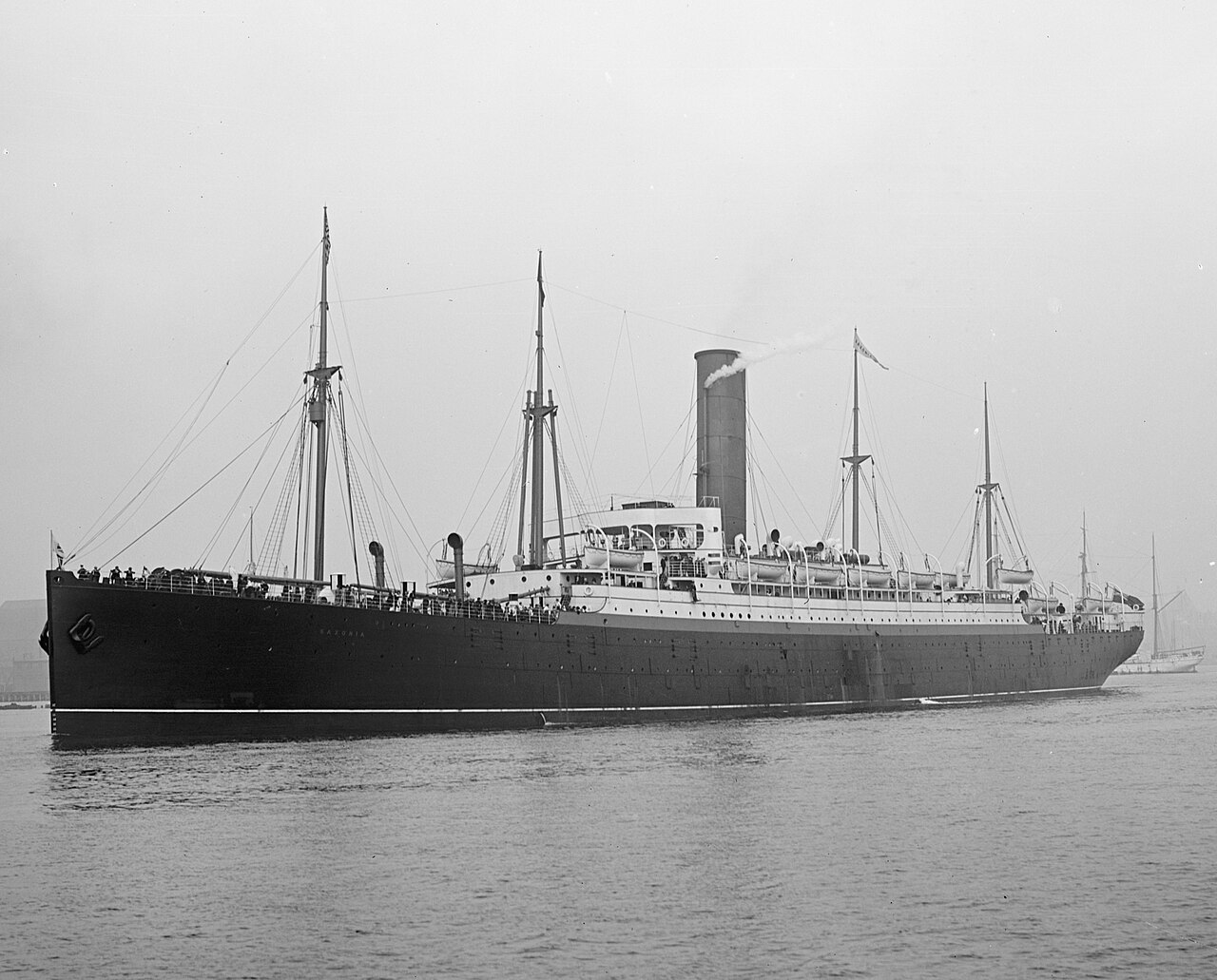
By 1900 many of Gloucester’s fishermen were Portuguese, most of them from the Azores. Joseph P. Mesquita, born in the islands in 1859, had come to Gloucester as a young man and become a schooner captain, and he named his vessel the Mary P. Mesquita after his daughter. Gloucester schooners fished Georges Bank and then raced home to sell their catch, crossing the busy steamer lanes out of Boston, often in fog.
On the evening of Saturday, October 27, 1900, the Mary P. Mesquita was coming home from Georges with a full hold. She had no wind and was drifting in fog about 27 miles south-southeast of Thacher’s Island when the Cunard liner Saxonia, which had left Boston that day for Liverpool, cut into her just forward of the main rigging. The schooner sank in about half a minute. The liner lowered her boats and saved all but one of the crew, some fifteen men. The man lost was Alfred Brown, a 38-year-old fisherman from the Azores with a wife and two children. The Saxonia carried the survivors on to Queenstown, Ireland, and the news reached America by cable from there on November 4. The crew came home to Boston aboard the Ultonia on November 18.
While waiting to be rescued, Captain Mesquita vowed to bring a crowning ceremony, as it was held in the Azores, to Gloucester in thanks for his crew’s survival. He kept the vow: a silver crown was sent from Portugal, and the first Crowning was held at Our Lady of Good Voyage Church in 1902. The ceremony is still held every year. The Gloucester poet Kitty Parsons told the story in The Wreck of the Mary P. Mesquita, from Gloucester Sea Ballads (1946). In her ballad, Alfred Brown dreams of smothering on the two nights before the wreck, and two of the schooner’s dories are found drifting off Cape Cod, so that everyone at home but the captain’s wife gives the crew up for lost.