On December 27, 2020, Nathan Evans, a postman in Scotland, posted a video of himself singing Soon May The Wellerman Come on TikTok. Other users added their own harmony and bass lines, and within weeks the song was everywhere. Its chorus is about waiting for supplies:
Soon may the Wellerman comeTo bring us sugar and tea and rum.One day, when the tonguin’ is done,We’ll take our leave and go.
Who was the Wellerman? The song’s new fans soon found an answer. The Weller brothers of Sydney ran a whaling station at Otago, in the South Island of New Zealand, in the 1830s, and their ships brought supplies to the whalers. The Wellers were real, their ships did carry sugar, tea, and rum, and for a few years their station was the biggest in the south. But the station’s history is darker than the song suggests, and the song itself is much younger than it sounds.
“The arts of peace and war”
The Wellers came from Folkestone, in Kent. Joseph Brooks Weller and his younger brothers George and Edward were in Sydney by about 1829, and their father followed after selling the family estate. Peter Entwisle, “Weller, Edward,” Dictionary of New Zealand Biography (1990), Te Ara. Joseph Brooks Weller lived from 1804 to 1835, George from 1805 to 1875, and Edward from 1814 to 1893. Sydney was then the business center of the New Zealand trade. Its merchants fitted out sealing gangs and, from about 1830, whaling parties, and New Zealand oil came into Sydney free of duty as colonial produce.
On September 25, 1831, the Wellers sent the Lucy Ann, a barque of 214 tons, to Otago Harbour, in the territory of Kāi Tahu (Ngāi Tahu), the principal Māori people of the South Island. The historian Robert McNab, who rebuilt the story from Sydney’s shipping and customs records for The Old Whaling Days (1913), printed her cargo list: Robert McNab, The Old Whaling Days: A History of Southern New Zealand from 1830 to 1840 (Christchurch: Whitcombe & Tombs, 1913). The Weller station is covered in chapter VI, “Weller’s Whaling Station, 1831 to 1835” (pp. 98–111), and in later chapters on the Otago trade. George Weller’s customs return of March 22, 1836 is on pp. 110–111, and his evidence of July 8, 1839 on pp. 278–279.
6 cases muskets, 10 barrels and 104 half barrels gunpowder, 1 case axes, 2 iron boilers, 5 casks beef, 1 case whaling gear, 1 case whaling line, 1 pipe gin, 2 puncheons rum, 5 kegs tobacco and stores.
It “combined the arts of peace and war to a charming degree,” McNab wrote. “Probably the ammunition was required for the natives, the alcohol for the whalers.” Muskets were the currency of the coast in the years of the Musket Wars, and Kāi Tahu were then at war with Te Rauparaha’s Ngāti Toa to the north.
The station went up near the Kāi Tahu village of Ōtākou, close to the harbor mouth. No record survives of what the Wellers agreed with the local chiefs. The start was a disaster. In April 1832 word reached Sydney that a fire had “burnt about 80 houses, totally destroying the whaling establishment,” and set off the gunpowder. A whole season was lost. Later that year a ship’s captain reported that one of the brothers had been seized on an island to be killed and eaten. One chief was friendly to him, “so they drew lots with pieces of wood when the friendly chief won, and Weller’s life was spared.” McNab does not say which brother it was.
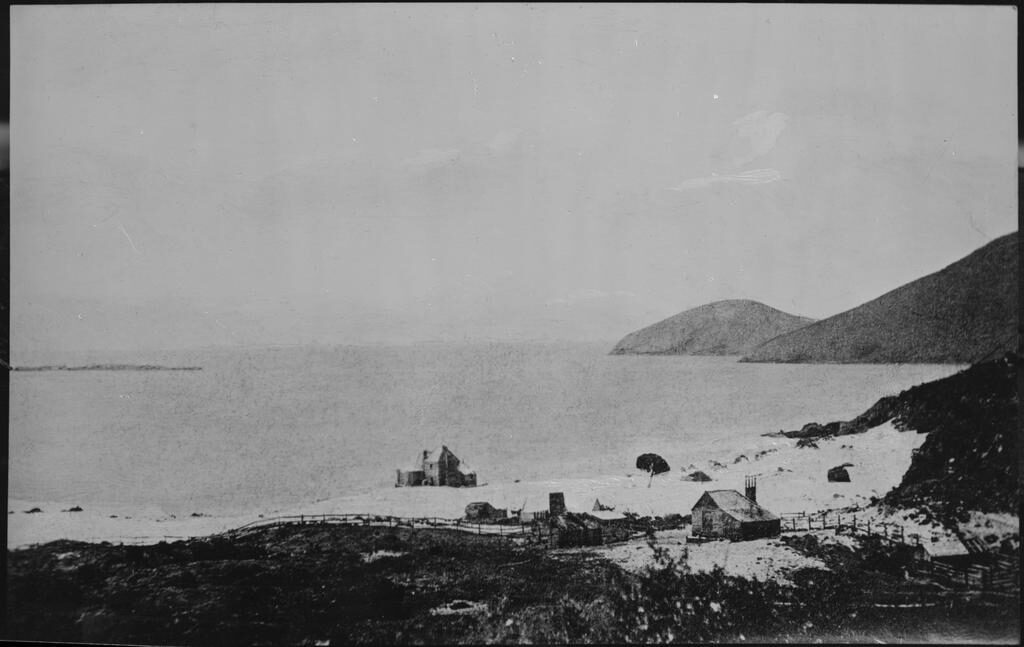
Then the whales came. On November 7, 1833, the Lucy Ann landed the first Otago oil at Sydney: 130 tuns (a tun was a cask of about 250 gallons) and seven tons of whalebone. “Whales were so plentiful,” McNab wrote, “that twice the cargo could have been procured had the ship possessed only a sufficiency of casks.” In March 1836 George Weller reported to the Sydney customs collector that 85 people had worked at the station the season before, three-quarters of them Europeans. By his figures it had produced 95 tuns of oil in 1833, 275 in 1834, and 430 in 1835.
The boat that takes the calf
The whales were southern right whales, called tohorā in Māori. Every winter, from about May to October, the females came into the sheltered bays of New Zealand to give birth. “Almost all the whales which are killed on the shores of New Zealand are females, or cows, and their calves,” wrote Ernst Dieffenbach, a German naturalist who watched the whalers at Te Awaiti, in Tory Channel, in 1839. The whalers knew that a cow would not leave her calf, and they used it: Ernst Dieffenbach, Travels in New Zealand (London, 1843), vol. 1, pp. 44–52 (“Whales and Whalers”); the “felled the tree” passage is on pp. 7–8.
It is, however, the affection of the whale for her young which becomes the principal means of her destruction. The calf, inexperienced and slow, is easily killed, and the cow is afterwards a sure prey.
The custom of the coast, wrote Edward Jerningham Wakefield, who traveled through the whaling stations in 1839, was that “the boat making fast to the calf has a right to the cow, because she will never desert her young.” Edward Jerningham Wakefield, Adventure in New Zealand, from 1839 to 1844 (London, 1845), vol. 1. The account of shore whaling is in chapter XI, pp. 316–337 (the tonguer, pp. 322–323; Wellington after the season, p. 337), and the visit to Te Awaiti in chapter III, p. 45. The Sydney merchant at Cloudy Bay was John Bell, whose 1831 letter is quoted in McNab, pp. 9–10.
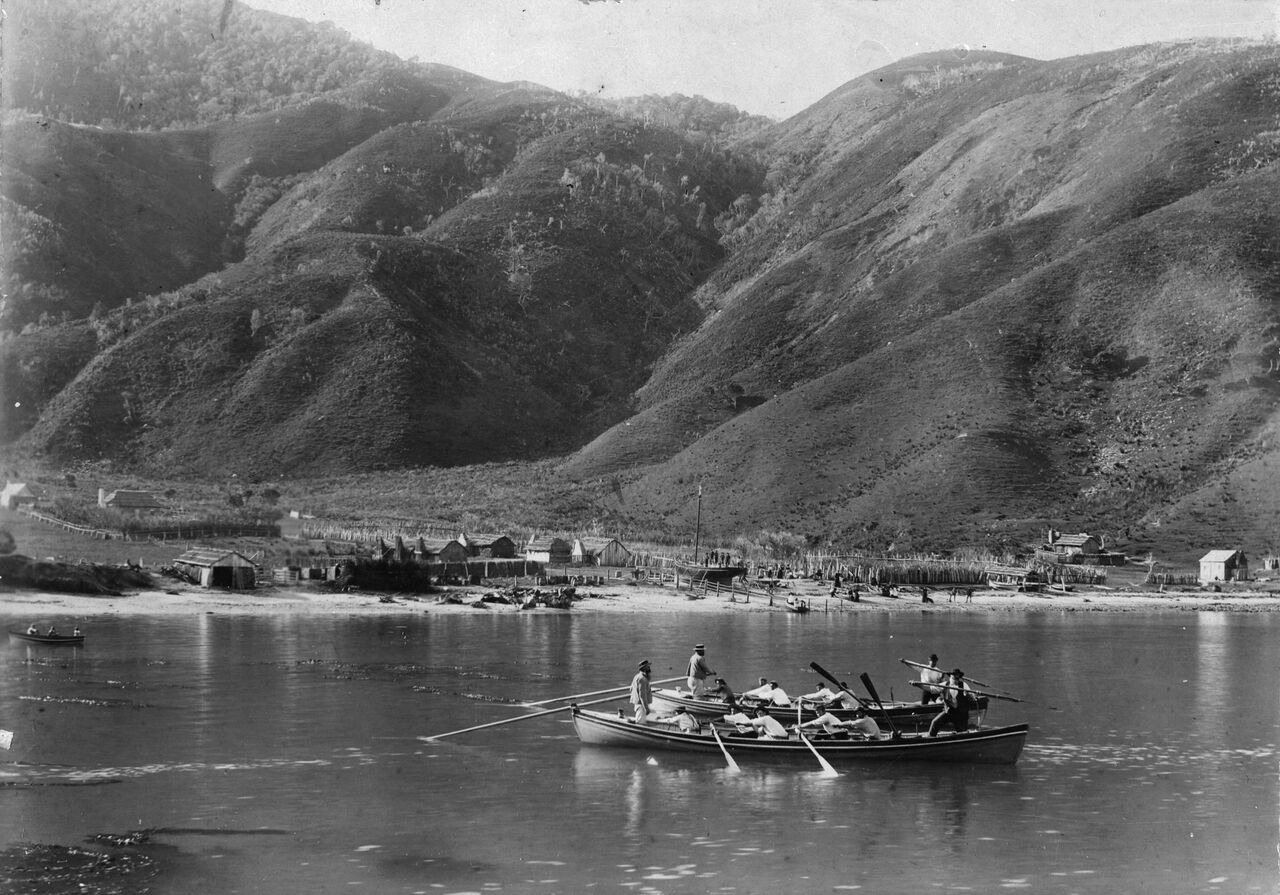
This was shore whaling, or bay whaling. Instead of chasing whales across the ocean in a ship, the whalers lived on the beach and rowed out after the whales that came into their bay. A lookout on a headland watched for spouts. Each whaleboat had a headsman, who commanded the boat and killed the whale with a lance; a boatsteerer, who threw the harpoon; and a crew of oarsmen. Once the whale was dead, the crew had to tow it home. A Sydney merchant who spent the 1830 season with a whaling party at Cloudy Bay wrote that he had “known the boats to be out for 14 hours pulling,” and that “killing the fish is a trifle in comparison with the getting it in.”
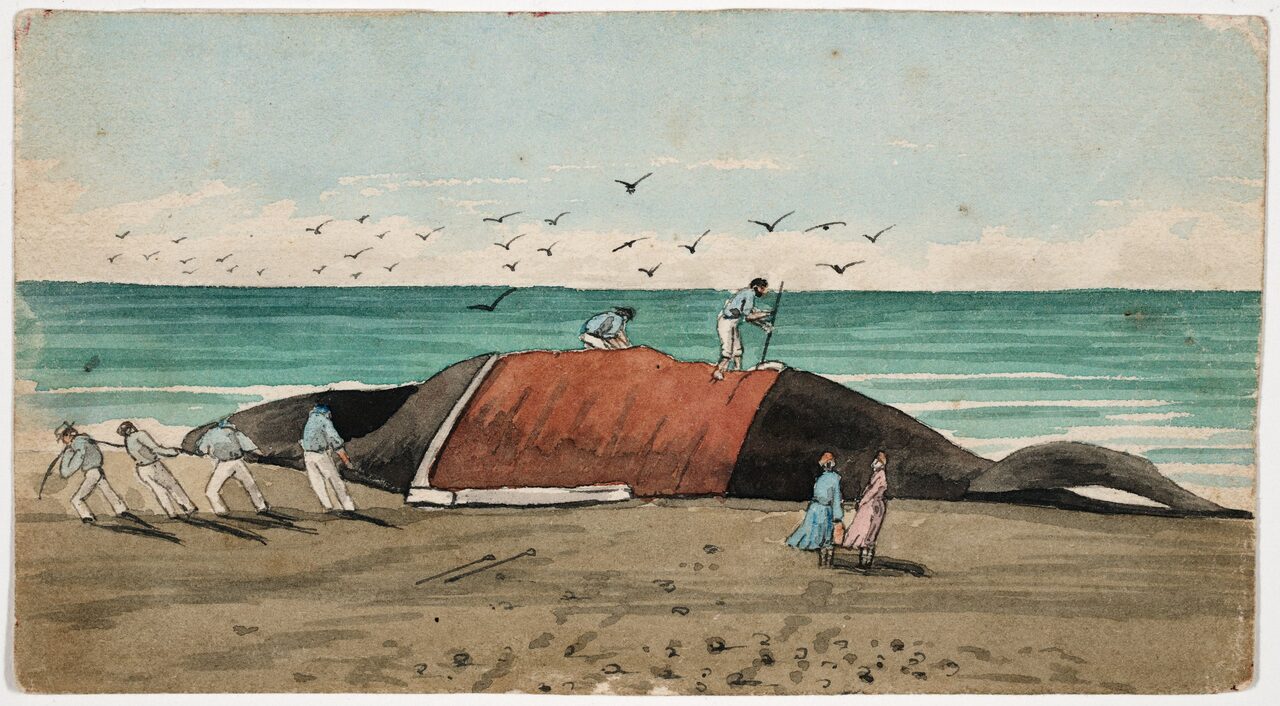
At the station, the carcass was hauled to the shore with a windlass and the blubber was cut off in pieces about two feet square. The man who did this was called the tonguer, because, Wakefield explained, he had “an exclusive right to the oil obtained from the tongue and other interior parts of the whale, in payment of his duty of ‘cutting-in,’ or dissecting, the whale.” The blubber was boiled down in the try-works, a row of big iron pots set over furnaces, and the boiled-out scraps were thrown on the fire as fuel. The work went on day and night until the whale was done. Wakefield reached Te Awaiti on a Sunday and found a gang at the try-works. He asked whether they always worked on Sundays. “Oh! Sunday never comes into this bay!” one of them answered. The beach was “saturated with oil, and the stench of the carcasses and scraps of whale-flesh lying about in the bay was intolerable.”
Many of the men in the boats were Māori. At Ōtākou, “an equal number of natives and Europeans were employed for the first four years,” according to Edward Shortland, who copied figures from the station’s own books in 1843. Edward Shortland, The Southern Districts of New Zealand (London, 1851). The account of how the stations paid their men is on pp. 109–112, with the scale of lays and the comparison of New Zealand and London prices in the footnotes. The figures for Ōtākou are in Appendix VI, pp. 300–301. Shortland took them from the “books and journals once kept at the establishment,” which Harwood showed him (p. 176). They differ from George Weller’s own figures for 1833 to 1835. Most of the European whalers lived with Māori women, and these marriages, often arranged with the women’s families, bound the stations to their Māori neighbors. Edward Weller’s first partner was Paparu, a daughter of the chief Tahatu. His second, Nikuru, was a daughter of the chief Taiaroa.
Sugar and tea and rum
The song’s Wellerman could be a Weller ship or one of the firm’s agents aboard it. Either way, the supplies came by sea from Sydney. On May 5, 1833, McNab records, the Wellers sent a whaling gang down to Otago with
a substantial cargo of flour, beef, sugar, salt, butter, vinegar, and pickles for their food; slops and cottons for their clothing; tar, pitch, lime, and 2000 bricks for their tryworks; 160 tuns casks for their oil; and brandy and rum for their refreshment.
“Slops” were cheap ready-made clothes for sailors. The whalers did not see much money. Each man was paid a “lay,” a fixed share of the season’s oil: a chief headsman took one eighteenth, a boatsteerer one sixtieth, and a common oarsman one hundredth. The Sydney merchant took the rest, and he also set the price of the oil. Shortland, who visited the southern stations in 1843 just after the Weller years, described how the system worked:
During the whaling season, the store was allowed to remain empty; but, as soon as it drew to a close, a ship came with a supply of spirits and goods suited to the tastes of the place, and received a return freight of oil. Each man had then a credit to the amount of his share, if he had not, as was generally the case, an old debt to wipe out. Forthwith all hands gave themselves up to drink the infamous rum, or arrack, with which they were supplied; and continued to do so as long as their credit lasted.
The goods were sold “at a price much above the cost in Sydney.” By Shortland’s reckoning, tobacco bought cheaply from American whalers was sold to the men at six times the price. Oil worth £30 a ton in London was valued on the beach at £8 to £12, “paid in rum, goods, and part cash.” The men were usually in debt, and so “in a manner bound to the place.” Octavius Harwood, the Wellers’ storekeeper at Ōtākou, noted in his journal in 1839 that he had “agreed with Gailey to work at 5/- [five shillings] per diem, to be paid in slops.” Harwood’s journal is in the Hocken Library, Dunedin, and is quoted in Alexandra King, “The Weller’s whaling station: the social and economic formation of an Otakou community, 1817–1850” (BA Hons dissertation, University of Otago, 2010). The Māori whaler was M. T. Erueti, interviewed in “A Chat with a Native of Otakou,” Otago Witness, July 1, 1897. A Māori whaler born at Ōtākou in 1844 put it more simply. Asked in 1897 what a crew got for a whale, he said, “Oh, a pair of pants and a couple of shirts, some grog and tobacco.”
So when the whalers in the song hope the Wellerman will come with “sugar and tea and rum,” they are waiting for their pay.
Hostages and measles
The Wellers needed the goodwill of Kāi Tahu, and they did not always earn it. In 1833 Joseph Weller warned the Hobart captain James Kelly that the people of Otago meant to seize his ship, because Kelly “had formerly killed or wounded several years ago some of their people.” In 1817 Kelly’s sealing ship Sophia had fought with the Otago people, and men had been killed on both sides. In 1834 about five hundred Māori arrived at the station after fighting at Cloudy Bay. They “struck Mr. Weller repeatedly,” broke open the whalers’ boxes, and “took the pipes out of the mouths of the servants.” Captain William Anglem of the Lucy Ann answered by persuading several chiefs to come aboard, shutting them below, and sailing “in the most secret manner” for Sydney, where they were held as hostages for the good behavior of their people.
The principal hostage was the chief Karetai, whom the whalers called Jacky White. In March 1835, after months in Sydney, he was sent home with his family in the brig Children, which the Wellers had chartered for Otago. There was measles on board. The ship called at Ruapuke and Ōtākou, and the disease spread through the southern villages, which had no resistance to it. By November 1836, the Sydney Herald put the Kāi Tahu death toll at 600. Michael J. Stevens and Rachel Standfield, “‘Picturing’ Kāi Tahu in 1830s Poihākena: A Preliminary Sketch,” Te Karaka (December 2021), which quotes the Weller correspondence and the Sydney Herald. The capture of the chiefs is described in McNab, pp. 103–104. Years later the whalers still called one Otago beach “Measly Beach,” “from the fact of so many natives residing in the vicinity dying of that complaint.”
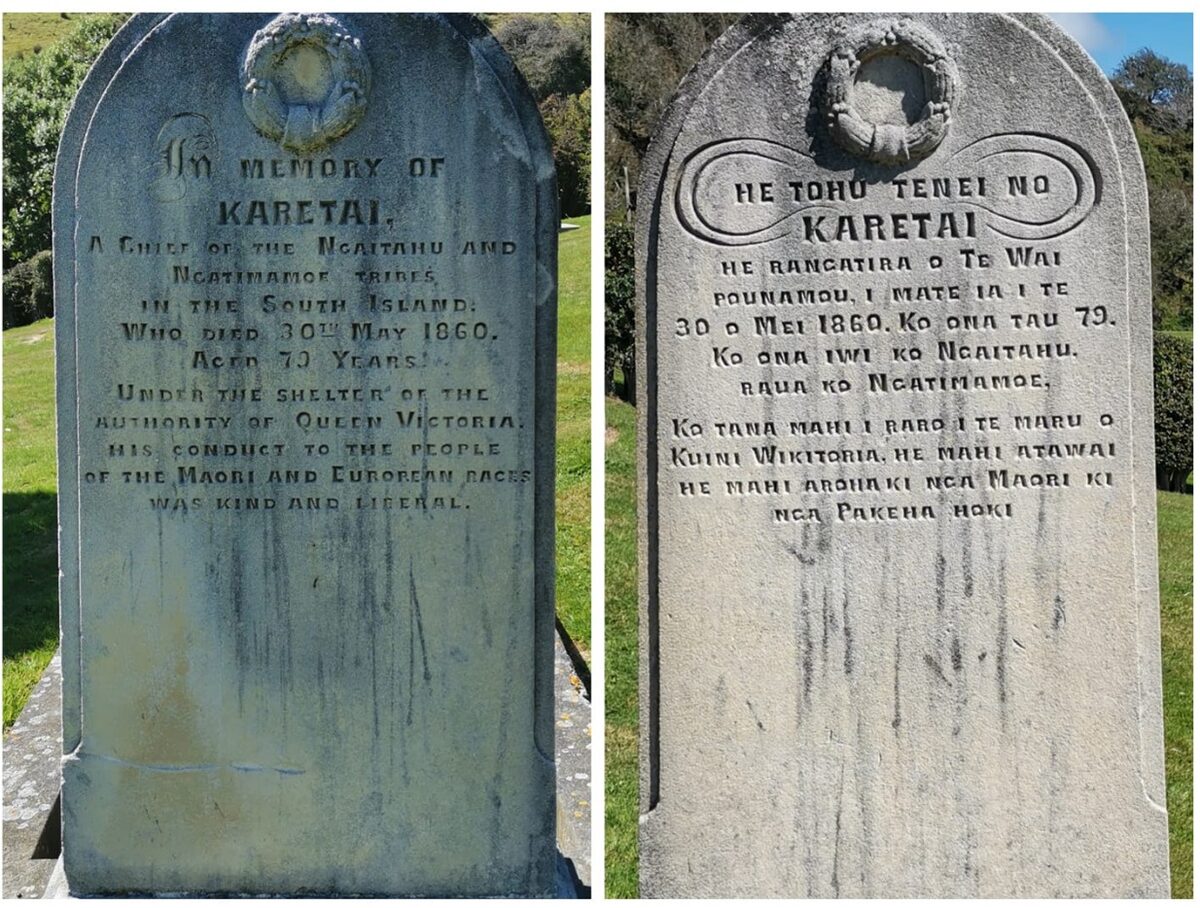
In the winter of 1835, Joseph Brooks Weller, the eldest brother, died of tuberculosis at the station. “His remains were preserved in a puncheon of rum,” McNab wrote, and shipped to Sydney on the barque Sushannah.
Land and ruin
Already by the late 1830s, the whales were thinning out, and the Wellers turned to land. On July 8, 1839, George Weller told a committee of the New South Wales Legislative Council that he had bought “in all, I imagine, amounting to about four hundred thousand acres, all of which I purchased from the Chiefs.” Many others in Sydney were buying New Zealand land the same way. A government official later remembered that “almost every captain of a ship, on arriving at Sydney from New Zealand, exhibited a piece of paper with a tattooed native head rudely drawn on it, which he described as the title-deed of an estate, bought for a few muskets, hatchets, or blankets.” Robert Carrick, ed., Historical Records of New Zealand South prior to 1840 (Dunedin, 1903), pp. 90 and 95–97. The official was the Native Commissioner Alexander Mackay. Carrick gives the Wellers’ claims as 3,557,000 acres in one place and 3,560,000 in another. By the time the claims were counted, the Wellers were claiming about three and a half million acres, for which they had paid a total of £153.
Britain was about to take over New Zealand, and it had no intention of honoring these deals. In January 1840 Governor Gipps of New South Wales proclaimed that the Crown would recognize no title to land in New Zealand that it had not granted or confirmed, and William Hobson repeated the proclamation when he arrived at the Bay of Islands at the end of the month. Days later came the Treaty of Waitangi. Every one of the Wellers’ claims was disallowed.
The whales were gone too. Shortland’s figures from the station’s books show the decline: 272 tons of oil in 1837, 213 in 1838, 65 in 1839, and 14 in 1840.
Edward left for Sydney in December 1840 and put the station in the hands of Charles Schultze, who had married his sister Anne. By the end of 1841 the firm had failed, and Schultze was advertising “two stations lately whaled at by Messrs G. and E. Weller” to let. When Shortland came to Ōtākou in 1843, he found himself “admiring the huge skeletons of whales which lay half-covered by the tide, or moralizing over several deserted and ruinous buildings, the evidences of former life and activity, which had only endured for a few years.”
Every station on the coast went the same way. “The shore-whalers, in hunting the animal in the season when it visits the shallow waters of the coast to bring forth the young,” Dieffenbach wrote in 1843, “have felled the tree to obtain the fruit.” Before the whalers came, between about 29,000 and 47,000 southern right whales wintered around New Zealand. The whalers took more than 80 percent of their total catch between 1830 and 1850, and by the 1920s only about 30 to 40 breeding females were left. Jennifer A. Jackson and others, “An integrated approach to historical population assessment of the great whales: case of the New Zealand southern right whale,” Royal Society Open Science 3 (2016). Their population figures for 2009 are also from this paper.
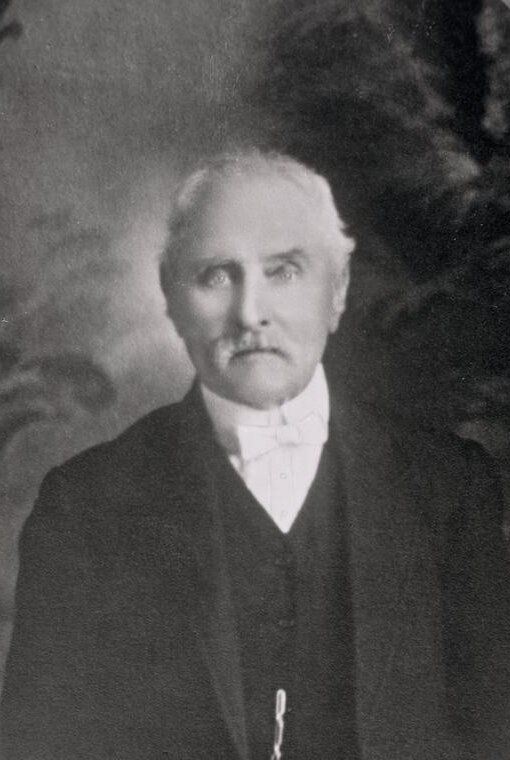
Edward Weller became a gentleman farmer in New South Wales and later claimed he had never been married. He died of exposure in the Maitland flood of 1893, sheltering in the roof of his house. Peter Entwisle, “Weller, Edward,” Dictionary of New Zealand Biography (1990), Te Ara. Joseph Brooks Weller lived from 1804 to 1835, George from 1805 to 1875, and Edward from 1814 to 1893. His daughter by Nikuru, Nani, stayed at Ōtākou. In 1888 her son Tom Ellison, a rugby player who later captained New Zealand, met Edward in New South Wales while on tour with a New Zealand team.
What the whalers sang
Visitors to the whaling coast wrote about the whalers’ work, their slang, and their nicknames, but none of them is known to have written down a whaling song. The music they did mention was mostly heard after the work was done. When the season ended and the men were paid off, Wakefield wrote, they went to Wellington to spend it, and “every public-house has its fiddle and hornpipe going.” In Otago Harbour in 1844, the crew of the Danish whaler St. Croix held a concert in which “captain, mate, boatswain, and cooper sang their English, German, and French songs until midnight,” with the cooper on the fiddle. T. M. Hocken, Contributions to the Early History of New Zealand (Settlement of Otago) (London, 1898), p. 49. Māori boat crews sang at the oars. Shortland was rowed across to Purakaunui by a crew who would “occasionally strike up a song, and pull lustily for a few minutes.” The chief Taiaroa even had an attendant the whalers called “Tom Bowling,” after the hero of a famous song by Charles Dibdin.
What the boat crews sang at work was probably the ordinary deep-sea repertoire. Around 1905, the writer James Cowan met an old Kāi Tahu seaman at Milford Sound. Michael Brown, a music historian and the music curator at the National Library of New Zealand, has identified him as Tohi Te Marama. Te Marama had sailed in the Post Boy, a schooner that went whaling and sealing along the southern coast with crews that were mostly Māori. Asked for the best song he knew from those days, the old man sang Sally Brown: “O, Sally Brown’s a bright mulatto. / O—oh—oh, roll and go!” In another account Cowan has the same man singing the anchor shanty Banks of the Sacramento, “the chantey that all the crews were singing those days as they hove up anchor.” Michael Brown, “‘The Chantey’ and ‘The Bush Poet’: James Cowan and Vernacular Song in New Zealand,” Journal of New Zealand Studies NS19 (2015), quoting Cowan’s “The Chantey,” Canterbury Times, June 12, 1912. The Sacramento account is Cowan’s “Tales of Bush and Ocean: The Whalemen of the Postboy,” Evening Post, April 26, 1913, where the seaman is called “old Mohi.”
One song does survive from the Otago whaling coast: a piece of comic verse later known as Whalers’ Rhymes, or The Beautiful Coast of New Zealand. In 1884 the Dunedin Evening Star printed it as “a few doggerel rhymes strung together as a song, the tune of which cannot now be recorded,” which “used to be sung by the whalers”: Evening Star (Dunedin), October 25, 1884. John Archer, who gives the text at folksong.org.nz, names Mrs. J. B. Hunter of Murdering Beach, just north of Otago Harbour, as its source. On the tune, see Brown’s MA thesis (cited below), p. 58. Haberfield’s memories appeared in the Evening Star of February 14, 1891, and Hughes’s move to Moeraki is recorded in “Reminiscences of Early Days,” Otago Witness, August 11, 1909. Kennard’s recollections are in Herries Beattie, The First White Boy Born in Otago (1939).
Along the coast the Magnet came,With Captain Bruce—a man of fame,But in his face there is no shame—On the beautiful coast of New Zealand.
The Magnet was not a Weller ship. She belonged to Johnny Jones, the Wellers’ great rival, who ran a string of stations up and down the coast from Waikouaiti. The song is a roll call of the southern whaling world of the early 1840s. Its people include a storekeeper at the Molyneux; Tūhawaiki, the Kāi Tahu chief the whalers called “Bloody Jack”; and the whalers Peter Shavatt, who “has a shocking bad hat,” and “old John Hughes, with his shocking bad shoes.” Hughes had worked at the Wellers’ station before he left in 1837 to start his own at Moeraki. William Haberfield, who came out from Sydney to work a season for the Wellers and then went with Hughes, remembered that “we sailed from Otago in the brig Magnet, Captain Bruce.” T. B. Kennard, who spent his boyhood at the whaling settlements of Waikouaiti and Moeraki in the 1840s, remembered the lines as “verses of doggerel” that people recited “in a jocular manner.” Later writers matched the verses to the tune of The King of the Cannibal Islands, a London comic song that an earlier Australian parody, The Beautiful Land of Australia, had already borrowed.
“Weller’s man”
Soon May the Wellerman Come is not in any source from the whaling years. The earliest evidence for it is a radio broadcast. Neil Colquhoun, a folk singer and collector, wrote Songs of a Young Country, a seven-part radio series, and the New Zealand Broadcasting Corporation aired it in October and November 1969. In the second episode Colquhoun sings the song himself. As Brown has pointed out, Colquhoun’s chorus is “Soon may the Weller’s man come.” Two years later, on the double LP Song of a Young Country (1971), Tommy Wood sang the familiar “Wellerman.” The text was first printed in Colquhoun’s book New Zealand Folksongs: Song of a Young Country (1972), with a headnote that gets the history right: Michael Brown, “Soon May the Wellerman Come,” Ngā Taonga Sound & Vision (2025), which also describes Colquhoun’s 1969 recording. Tommy Wood’s account was posted by Mike Harding to the Mudcat Café forum on November 13, 2022. Colquhoun’s editorial policy is from the introduction to New Zealand Folk Songs (Auckland: WEA, 1965), and the Leebrick letter is described in Brown’s MA thesis, “There’s a Sound of Many Voices in the Camp and on the Track” (Victoria University of Wellington, 2006), pp. 50–51.
Shore whalers, unlike the whalers on ships, could not return to their native land. Even if there were a ship, they couldn’t afford the passage; for they saw no money. Whaling companies such as Wellers’ of Sydney, sent agents across the Tasman to collect the bone and oil; and to pay the men in sugar and rum.
Where did Colquhoun get the song? The book credits Frank Woods of Wairoa, who was said to have learned it from an uncle, but nobody has identified Woods. Tommy Wood remembered it differently. In a statement that the New Zealand folk singer Mike Harding posted online in 2022, Wood said he had found “the poem in a book on NZ sailors” that his wife, a librarian, brought home, that Colquhoun “hummed a rough guide to the tune,” and that he “had to adjust some of the words to fit.” The book has never been found. Colquhoun was open about his own methods. In the introduction to his first collection, he wrote that he had followed the American collector Alan Lomax: “I have combined versions, and composed words and melodies where these have been forgotten.” Brown has searched New Zealand’s digitized newspapers and found “Wellerman” only as a surname before 1972. Colquhoun, he suggests, “may have even coined the term.”
The lyrics fit the 1830s only loosely. The story is about a whaling ship towed across the sea by a harpooned whale, while the Wellers ran shore stations, and their ships met their whalers in harbor, not at sea. A “billy” as a can for boiling tea is not recorded in print before the 1840s, so the ship’s name, the Billy of Tea, is unlikely to be older. “Tonguin’” is harder to pin down. The tonguer was a real job, but no one has found “tonguing” used as a verb by the whalers themselves. The word also turns up in a song that Colquhoun’s group, the Song Spinners, recorded in 1958, Come All You Tonguers, whose singer is “paid in soap and sugar and rum / For cutting in whale and boiling down tongue.” Colquhoun got this song in 1957, in a letter from John Leebrick, an American composer who said he had collected it from the daughter of an American whaling captain. Leebrick died soon afterward, and his source has never been traced.
Colquhoun, or Wood, or whoever made the song, understood the shore whalers well. The whalers lived on credit and waited all season for a ship from Sydney with the goods that stood in for their wages. That is the story the chorus tells.
The Wellerman comes again
Nathan Evans said he learned the song from recordings he found on Spotify, including one by the Albany Shantymen, from Western Australia. The Longest Johns had recorded it on Between Wind and Water in 2018, and their version reached the British Top 40 in January 2021. Evans’s own single, remixed by the producers 220 Kid and Billen Ted, went to No. 1 on the UK Singles Chart in March 2021.
In Otago, the news was taken personally. “This was the hub,” the Kāi Tahu elder Edward Ellison, a great-great-grandson of Edward Weller, told the Otago Daily Times. “I would expect it probably originated from here.” Molly Houseman, “Wellerman sea shanty a global hit,” Otago Daily Times, January 23, 2021; “Sea shanty about NZ settlers resurfaces about 190 years later,” RNZ, January 26, 2021. Some of his relatives, he told Radio New Zealand, were “converting the song into a waiata,” with Māori words.
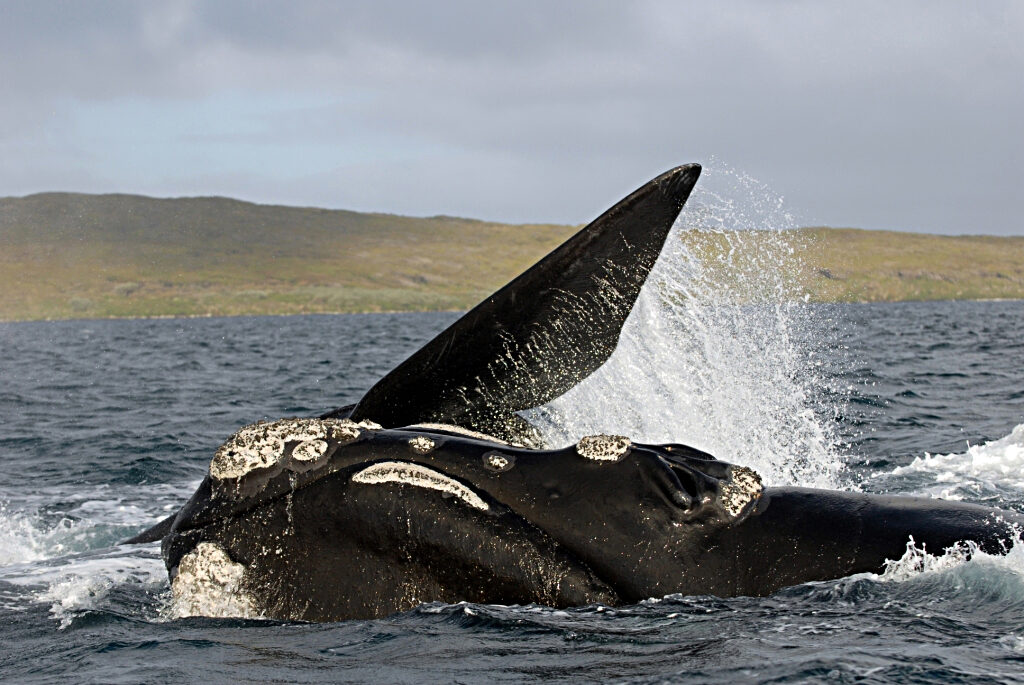
Almost 200 years after the Wellers’ station opened, the whales are coming back too. New Zealand’s shore whalers killed their last right whales in Tory Channel in 1927, and for the next 36 years none were seen off the mainland. Then, on July 15, 1963, a right whale appeared in Tory Channel. Nigel Prickett, “The Archaeology of New Zealand Shore Whaling” (Department of Conservation, 2002), p. 2. Protected since 1936, the tohorā survived in the sub-Antarctic waters around the Auckland Islands. By 2009 there were about 2,200 of them, growing at about 7 percent a year, and they are slowly returning to the mainland bays where their calves were once born and killed.